Robinhood Chain Primer: Early Traction and Protocols to Watch
Less than three weeks after its mainnet launch, Robinhood Chain is already rivaling top L2s in activity.

Investing in digital assets or tokenized equities involves a substantial degree of risk. Market prices can be highly volatile and unpredictable. Movements in the market can result in significant, rapid, and potentially total loss of your invested capital. Before allocating capital, you should carefully evaluate whether such investments align with your financial situation, experience, and risk tolerance. For further information regarding potential risks, please refer to the disclaimer below. In addition, FalconX supports Robinhood Chain as a liquidity partner/market maker for its on-chain protocols.
Robinhood Chain Primer: Early Traction and Protocols to Watch
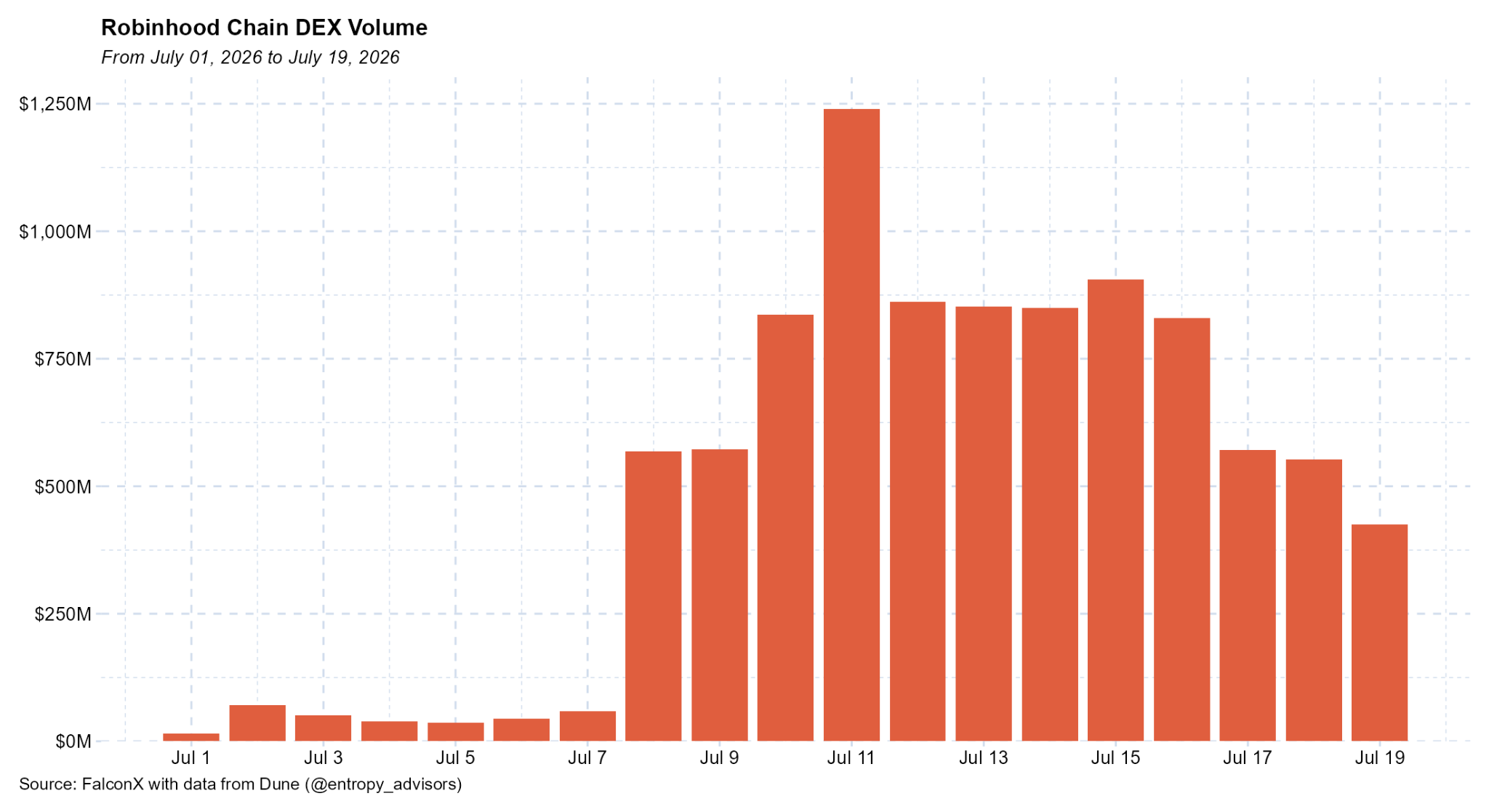
Activity on Robinhood Chain appears to be steadily increasing after mainnet went live on July 1. Protocol TVL stood at $431M as of July 19, according to data from Entropy Advisors, while stablecoin market cap was nearly $400M. User activity appears just as robust – transactions of 6M/day and DAUs of 250k+ place Robinhood Chain as a top blockchain by activity, even flipping the Base L2 on some days, per data from Artemis. Total DEX volumes on the chain have totaled $9B+, although 80%+ of activity is related to higher-risk memecoins.

The chain’s stated focus on tokenized real world assets (RWA) stands as a potential differentiator. Robinhood CEO and co-founder Vlad Tenev stated on X that they want to hear from builders looking to embed stock tokens or RWA into their apps, underscoring the direction they want to steer the chain to.
The Crypto Opportunity for the New Chain
Considering Robinhood’s customer base of nearly 28M, largely retail, bringing this cohort on-chain could generate substantial activity across its network and applications.
The other, and potentially more important, reason this chain is worth monitoring is its focus on tangible use cases, such as lending out tokenized assets. These are features the crypto industry has championed, but have yet to materialize on a large scale. By focusing on utility and on-chain financial services, the platform is positioned to help validate crypto product-market fit on a global scale.
Moreover, because the ecosystem is not centered around potential airdrop farming, user participation is more likely to be driven by actual utility, making this network a genuine barometer of crypto adoption.
Robinhood Chain Overview
Robinhood Chain is an Ethereum L2 based on the Arbitrum tech stack. It uses ETH for gas. The chain features block times of 100ms. As with most L2s, there is a 7-day withdrawal period back to L1 Ethereum. The chain itself is open and permissionless, in line with peer L2s, supporting builder innovation and global access. Its public mainnet launched on July 1, 2026, following its public testnet on February 10, 2026.
By using the Arbitrum tech stack, which powers Arbitrum One (a top L2 by DeFi activity for years, per DefiLlama), Robinhood Chain appears to benefit from broader integration support, such as EVM tooling and dapp and exchange connectivity. This has enabled it to launch its mainnet with a large cohort of partners and major dapps, helping to support growth in activity. As Robinhood Chain uses Arbitrum’s tech and settles outside of Arbitrum One (it is a standalone L2 that settles on ETH and not an L3), it pays 10% of net chain revenue to Arbitrum. Since it uses Ethereum L1 for data availability and settlement, it must also pay Ethereum for these costs, which have totaled around 60 bps of fees in practice.
Importantly, the chain is described as built for financial services and tokenized real-world assets (RWA), supporting Robinhood’s vision of an ecosystem where assets can be programmatically traded, self-custodied by users, and accessible 24/7.
In line with this RWA focus, Robinhood rolled out new Stock Tokens which can be used on-chain as ERC-20 tokens, unlike its previous classic stock tokens which could not be transferred out of the Robinhood app. The new stock tokens are structured as tokenized debt securities issued by Robinhood Assets (Jersey) Limited (RHJ). These instruments provide only economic exposure to the underlying security and are backed 1:1 by the underlying stock held by a US custodian. These are largely meant to be obtained through secondary markets, with only authorized participants able to mint or redeem directly with the issuer. These features bring Robinhood’s current tokenized stock offerings in line with those of leading issuers such as Ondo and xStocks.
Stablecoin Market Cap
Stablecoin market cap has grown to $396M, namely across USDG (issued by Paxos) and USDe (Ethena). USDG is the chain’s first natively issued stablecoin. The decision to use USDG could stem from Robinhood’s involvement as an initial partner of the Global Dollar Network, a consortium with 100+ partners that backs USDG. USDG differentiates itself from other stablecoins through its reserve revenue share with partners. USDG plays an important role in the network as the lending asset in the Earn product.
Meanwhile, the significant USDe presence is explained by its Robinhood Earn integration, serving as yield generating collateral. Ethena said it had been selected by Steakhouse, the curator of the vault, as the primary collateral asset issuer for Robinhood's first crypto earn product.

Robinhood Earn and its Lloyds of London Differentiator
Robinhood Earn is a decentralized lending product available through the main Robinhood app. Users can lend USDG through vaults powered by Morpho and supported by Steakhouse, Ethena, Spark, and Maple.
Notably, the Robinhood Earn product is insured through Lloyd’s of London and RELM for losses related to a cyber event or smart contract exploit, where if a covered event occurs, Robinhood (as the policyholder) may use insurance proceeds for loss mitigation. This kind of insurance is apparently rare for a DeFi offering and contrasts with Coinbase’s Morpho offerings which are uninsured. More importantly, it signals confidence in DeFi even when concerns have grown about smart contract security risks in light of increasing AI model capabilities. The caveat here is that the covered limit was not published, still leaving some uncertainty as the vault scales. However, Robinhood stated in its chain announcement presentation that it could be one of the largest, if not the largest insurance programs across the crypto industry.
Robinhood Earn shows an estimated 7% APY for depositors, a rate much higher than traditional high yield savings accounts (ex: 3.40% APY at Marcus) but could reflect customer acquisition subsidization rather than natural borrowing demand. Per data from Morpho, Steakhouse’s USDG vault on Robinhood Chain pays an APY of 1.9% as of July 20, 2026, while the USDe/USDG Morpho market shows an APY of 2.5%. This suggests that Robinhood is somehow subsidizing the difference, with reports of a Merkl campaign that pays the gap in yields, which analysts estimate could support the 7% APY target up to vault TVL of approximately $2B.

Its Earn product may compare to Coinbase’s high yield USDC vault, which crossed $200M in deposits a month after going live and is in partnership with Steakhouse and Ethena. The vault offers yields of 7%, in line with Robinhood’s offering.
User Activity

The chain’s 1W fees currently annualize to $57M, per Artemis, vs $37M for Base. Data from Robinhood Chain’s block explorer Blockscout points to roughly 1.5M total accounts on the chain as of July 19. As of the same date, it had around 245K DAUs, per data from Artemis, in line with other L2s such as Base (255K), and ahead of Arbitrum (99K), but below Ethereum (370K). On the same day it did 6.5M of transactions which compares to 6.0M for Base.
In terms of 24H DEX Volume, Robinhood Chain ranked 5th per data from DeFiLlama with $438M volume, behind Base ($586M) but ahead of Arbitrum ($73M). The data suggests strong traction for the newly launched chain, especially relative to its L2 peers. The caveat is that the initial burst of activity may reflect hype over substance, considering memecoins seem to be a key driver of activity, and could taper off if memecoin volumes decline.

RWA Activity So Far
While a focus on RWA has been highlighted as part of the vision for Robinhood Chain, the activity in these assets is still early days. So far stock token volume has been negligible, with the highest daily trading volume of $8.5M across spot DEXes. According to data from RWA.xyz, there are $14M of Robinhood tokenized stocks so far, which compares to $851M and $481M for Ondo and xStocks, respectively, although those instruments were around for much longer. However, considering Robinhood’s customer base and efforts to onboard users on-chain, it is possible its tokenized stock offering could rival these incumbents as its chain matures.
The Protocols Driving Initial Activity on Robinhood Chain
Morpho – The underlying vault infrastructure powering Robinhood Earn. Per data from Entropy Advisors, Morpho Markets on Robinhood Chain had a total market size of $280M as of July 19. Morpho vault TVL was approximately $194M, driven by the Steakhouse USDG vault and the Ethena x Steakhouse vault.
Maple – Rolled out syrupUSDG on Ethereum and Robinhood Chain which is its first new Syrup asset in 2 years. Deposits into syrupUSDG are used to make overcollateralized loans to institutional borrowers, with holders receiving interest. Curator Steakhouse Financial approved syrupUSDG as collateral for a vault behind Robinhood Earn. As of July 19, syrupUSDG has grown to $218M TVL per the company’s Dune dashboard, although data from Blockscout points to $30M supply on Robinhood Chain itself.
Uniswap. Launched on Robinhood Chain as its primary public AMM and also supports trading via UniswapX. Much of the activity has been in ETH and USDG, while memecoins such as CASHCAT have also posted relatively strong volumes. Memecoins appear to be behind much of DEX activity overall on Robinhood Chain, with approximately $8B of cumulative memecoin DEX volumes as of July 19, 2026. This compares to around $9B of total DEX volume on the chain, which has largely been on Uniswap. Data from Entropy Advisors shows around 75% of overall spot DEX volume on Robinhood Chain in recent days was memecoin related, down from 90% initially.
Uniswap also has a presence in token launches (including memecoins) on Robinhood Chain. It launched its Continuous Clearing Auctions and Uniswap Auctions functionality on July 13, enabling builders to run on-chain token auctions. On July 13, tokens launched via Uniswap Auctions saw $13M of volume versus $131M for tokens launched via Noxa.
Concurrently, Uniswap is voting on expanding protocol fees to Robinhood Chain and is moving in parallel to activate protocol fees across Uniswap v4 pools.
Lighter. Powers perpetual futures trading on the Robinhood Wallet. Lighter committed $11M for LIT for rewards. So far, activity remains relatively low, with the largest markets by open interest and volume at $294K and $583K (BTC and USAR perps, respectively).
Ethena. Selected by Steakhouse, the curator of the vault, as the primary collateral asset issuer for Robinhood's first crypto earn product. As of July 19, USDe on the chain has a market cap of $103M, with much of this in Morpho.
On July 9, Ethena announced that it reduced the USDe mint/redeem fees to 0 for stablecoins including USDC and USDG. Consequently, looping on the Coinbase and Robinhood Morpho vaults are now cost free at mint and redemption, which could help drive activity.
Virtuals. The AI agent protocol saw 4,500+ agents launched and $150M+ in agent volume on Robinhood Chain, with agent builders raising $2.3M+. It said live products span AI trading, yield optimization, privacy infrastructure, dev tools, token intelligence, RWA (tokenized tax liens), collectibles, and agent-to-agent services. The project sits in the AI agent stock trading narrative that Robinhood highlighted in its July 1 presentation.
Arbitrum. Robinhood Chain is built on the Arbitrum tech stack and pays Arbitrum 10% of net protocol revenue. This fee flows 80/20 to the Arbitrum DAO (where the DAO treasury is controlled by ARB token holders) and Arbitrum Developer Guild, giving the DAO 8% direct value accrual from Arbitrum Chains.
Initial data, per Entropy Advisors, shows the Ethereum L1 capturing around 0.60% of fees on Robinhood Chain, which compares to Arbitrum’s 10%. This suggests Arbitrum is a greater beneficiary of Robinhood Chain activity, although the fact that the chain uses ETH as its native gas token may strengthen the ‘ETH as money’ narrative.
Arcus. This is a spot and perps DEX built by the team behind DYDX. Per DefiLlama, it has seen daily perps volume grow to up to $7M, while daily spot volume hit a high of $5M. Its perp offering is still gated via waitlist – activity could increase as access increases.
Noxa. Token launchpad Noxa.fun has driven the vast majority of launchpad token volume for Robinhood Chain. This was the launchpad behind the chain’s leading $CASHCAT memecoin, which hit a high of nearly $200M market cap on July 10. Tokens created on Noxal aunch straight into a Uniswap v3 pool instead of going through a bonding curve first. However, its initial traction has faltered after its domain went down and was reported as possibly being compromised.
Flap. Token launchpad Flap replaced Noxa as the leading launchpad by tokens deployed in recent days. Unlike Noxa, Flap has a bonding curve stage for tokens launching through it.
Takeaways
Robinhood Chain appears positioned to onboard millions of its users on-chain and explores key unlocks of crypto technology, especially with regards to RWA. Early activity so far suggests strong user interest, although memecoin trading dominates DEX volumes. Over time, it seems reasonable to expect lending TVL on the chain could see growth on its headline 7% APY, Robinhood app integration for accessibility, as well as its insurance coverage, with Morpho standing to be a key beneficiary. Ultimately Robinhood’s stated focus for the chain is RWA so tokenized stock market cap as well as functional on-chain utility for these tokens could be key drivers of activity going forward.
This material is for informational purposes only and is only intended for sophisticated or institutional investors. Neither FalconX Limited, FalconX Bravo, Inc., FalconX Delta, Inc., FalconX Foxtrot Pte Ltd., FalconX Golf Pte Ltd., Solios, Inc., Falcon Labs, Ltd., KestrelX, Ltd. nor Banzai Pipeline Limited service retail counterparties, and the information in this material is NOT intended for retail investors. This material is not (i) an offer, or solicitation of an offer, to invest in, or to buy or sell, any interests or shares, or to participate in any investment or trading strategy, (ii) intended to provide accounting, legal, or tax advice, or investment recommendations, or (iii) an official statement of FalconX or any of its affiliates. Any information contained in this material is not and should not be regarded as investment advice, investment research, debt research, or derivatives research for the purposes of the rules of the CFTC or any other relevant regulatory body.
No discussion of a particular company or product shall be considered an endorsement of such company or product. Past performance is not indicative of future results. FalconX, and its affiliated parties, including 21shares, may hold positions in, act as a market maker for, or otherwise have a financial interest in, assets discussed herein, and may benefit from any price movements or transactions involving the subject company. This may change without notice. Prior to entering into any proposed transaction, recipients should determine, in consultation with their own investment, legal, tax, regulatory, and accounting advisors, the economic risks and merits, as well as the legal, tax, regulatory and accounting characteristics and consequences of the transaction. Pursuant to the Dodd-Frank Act, over-the-counter derivatives are only permitted to be traded by "eligible contract participants" (“ECP”s) as defined under Section 1a(18) of the CEA (7 U.S.C. § 1a(18)). Do not consider derivatives or structured products unless you are an ECP and fully understand and are willing to assume the risks.
Solios, Inc. and FalconX Delta, Inc. are registered as federal money services businesses with FinCEN. FalconX Bravo, Inc. is registered as a Swap Dealer with the U.S. Commodities Futures Trading Commission and is a member of the National Futures Association. FalconX Limited, FalconX Bravo, Inc., FalconX Delta, Inc., Falcon Labs Ltd., and Solios, Inc. are not registered with the Securities & Exchange Commission or the Financial Industry Regulatory Authority. FalconX Golf Pte. Ltd. is not required to be registered or licensed by the Monetary Authority of Singapore (MAS). MAS has granted FalconX Foxtrot Pte. Ltd. a temporary exemption from holding a license under the PSA for the payment services caught under the expanded scope of regulated activities for a specified period. FalconX Limited is licensed by the MFSA as a Class 2 Crypto-Asset Service Provider (Regulation (EU) 2023/1114). It is also licensed as a Financial Institution (Cap. 376) exclusively for EMT payment services.
"FalconX" is a marketing name for the FalconX Group and its affiliates. Availability of products and services is subject to jurisdictional limitations and capabilities of each FalconX entity. For information about which legal entities offer trading products and services, or if you are considering entering into a derivatives transaction, please reach out to your Sales or Trading representative.
.jpg)