Crypto's Asymmetric Post-Clarity Rally
Crypto assets rallied despite the Clarity Act failing to advance in the Senate and a rate hike by the Fed.

Investing in digital assets or tokenized equities, and their respective derivatives, involves a substantial degree of risk. Market prices can be highly volatile and unpredictable. Movements in the market can result in significant, rapid, and potentially total loss of your invested capital. Before allocating capital, you should carefully evaluate whether such investments align with your financial situation, experience, and risk tolerance. For further information regarding potential risks, please refer to the disclaimer below.
Although the highly anticipated cloture vote on the Clarity Act failed in the Senate, crypto assets rallied towards the end of the week, climbing a wall of worry including a 25 bp rate hike on Wednesday. A key reason seems to be the swift post-vote response from the SEC and CFTC to announce new rules for the industry, setting a path for constructive regulation to occur even without legislation firmly in place. The substance and scope of the agencies’ announcements appear to be contributing to broader risk-appetite across crypto assets, with several tokens rising to record highs and majors breaking out of their 4-week range.
The SEC’s Innovation Exemption
The SEC announced an innovation exemption around tokenized stock trading where tokenized securities venues (TSVs) are exempt from the definition of “exchange” to trade tokenized National Market System (NMS) stock using permissioned automated market makers (AMM) and liquidity pools. Tokenized NMS stocks must provide holders the same rights and privileges (such as dividends and voting rights) as the stocks purchased in a brokerage account, unlike synthetic tokenized stock tokens which typically only provide economic exposure. Notably, companies who do not want their stock trading on TSVs can opt out. Furthermore, certain liquidity providers that provide capital into the related AMM pools are exempt from the definition of “dealer”. Importantly, the exemption states “smart contracts used by a TSV must be auditable, public, and deployed on a public, permissionless distributed ledger.” Moreover, the pools/trading must be permissioned.
This means leading smart contract blockchains (ETH, SOL) that fall under the public and permissionless ledger category, as well as their AMM protocols (such as UNI, AERO, RAY), could be well positioned for any activity in this area. UNI, for example, already has permissioned liquidity pool offerings, setting it up for compliance in this space. While just an initial step, and not applicable to the vast majority of tokenized stocks today, it sets a path for large-scale tokenized stock activity to come on-chain.
CFTC-Related Developments
On September 17, the CFTC submitted a crypto market structure framework, an administrative step that sets up the path to deliver rulemaking that the Clarity Act would have provided. The CFTC’s Market Participants Division staff also issued a no-action position to providers of passive software (such as front-ends and self-custodial wallet providers). Subject to certain conditions, the division will not pursue enforcement against these providers for failing to register as introducing brokers in regard to facilitating trading by the provider’s users with registered futures commission merchants, introducing brokers, and designated contract markets. This position extends a March 2026 relief for Phantom wallet, making a similar framework available more broadly. In practice, qualifying providers can act as distribution channels for onshore derivatives markets (perpetuals, traditional futures, and event contracts) without registering as introducing brokers.
On September 18, Coinbase, Payward (Kraken), and Kalshi filed to list single-stock and ETF perpetuals, indicating a possible expansion of perpetuals amongst US venues under joint CFTC/SEC oversight. If approved, this could add to the list of markets that passive software providers support under the relief action.
Separately, Payward announced plans to offer on-chain perpetual futures to US clients, starting with Hyperliquid HIP-3 markets. Its CFTC-regulated exchange and clearinghouse Bitnomial would be the HIP-3 deployer, while its CFTC-registered FCM NinjaTrader would carry client accounts. The timing of the move is notable; it suggests confidence that the CFTC could move to approve such on-chain perpetual offerings soon, in line with its stated goal of onshoring perpetuals.
In practice, these would be permissioned markets for Payward clients only, just on Hyperliquid infrastructure. Considering these markets would be siloed from the rest of Hyperliquid liquidity, advantages of this offering may be limited in the proposed form.
The Post-Innovation Exemption Setup
Following the flurry of agency announcements and related developments, crypto has rallied asymmetrically. Majors (BTC, ETH, SOL) are up 8%-15%, breaking through the top end of their multi-week range. BTC, for example, has oscillated around $76K-$82K since late August, and rallied through this range to $85K on September 21, its highest since January.
Meanwhile, several tokens are significantly outperforming. These include a mix of privacy-related names (NEAR, ZEC, VVV) as well as DeFi names adjacent to agency developments (UNI, AERO, HYPE).
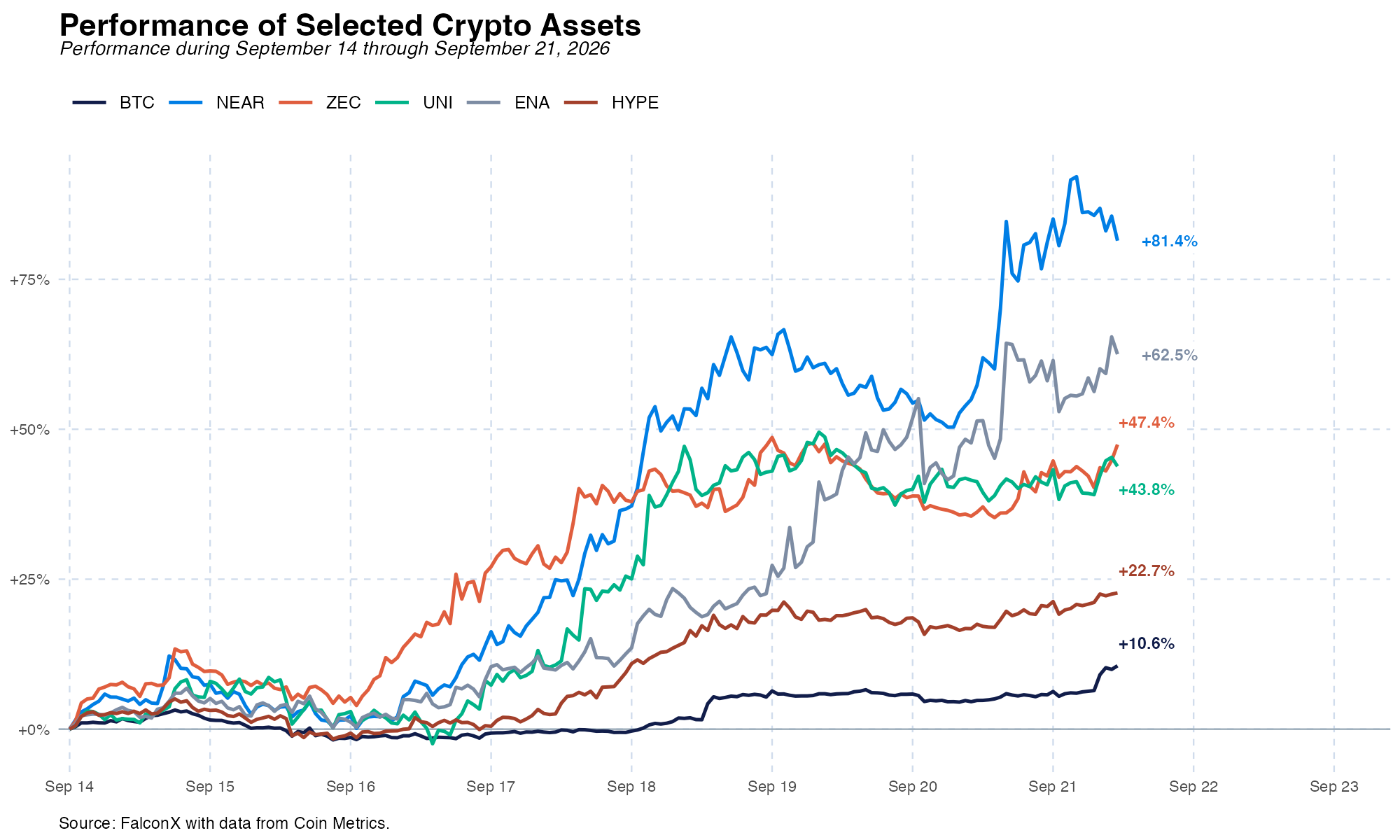
Driving the privacy narrative are two key headlines, including a shift towards stricter worldwide income taxation in China, where Beijing is reportedly cracking down on offshore assets of wealthy Chinese tax residents. Moreover, suspicions that OpenAI may have used a scientist’s prompts for their own research have driven awareness about the need for private inference and private transactions more broadly. Consequently, this seems to be lifting privacy-adjacent names such as ZEC (private store of value asset), VVV (private inference), and NEAR (private inference and trading). The outperformance may also reflect idiosyncratic developments, such as the below.
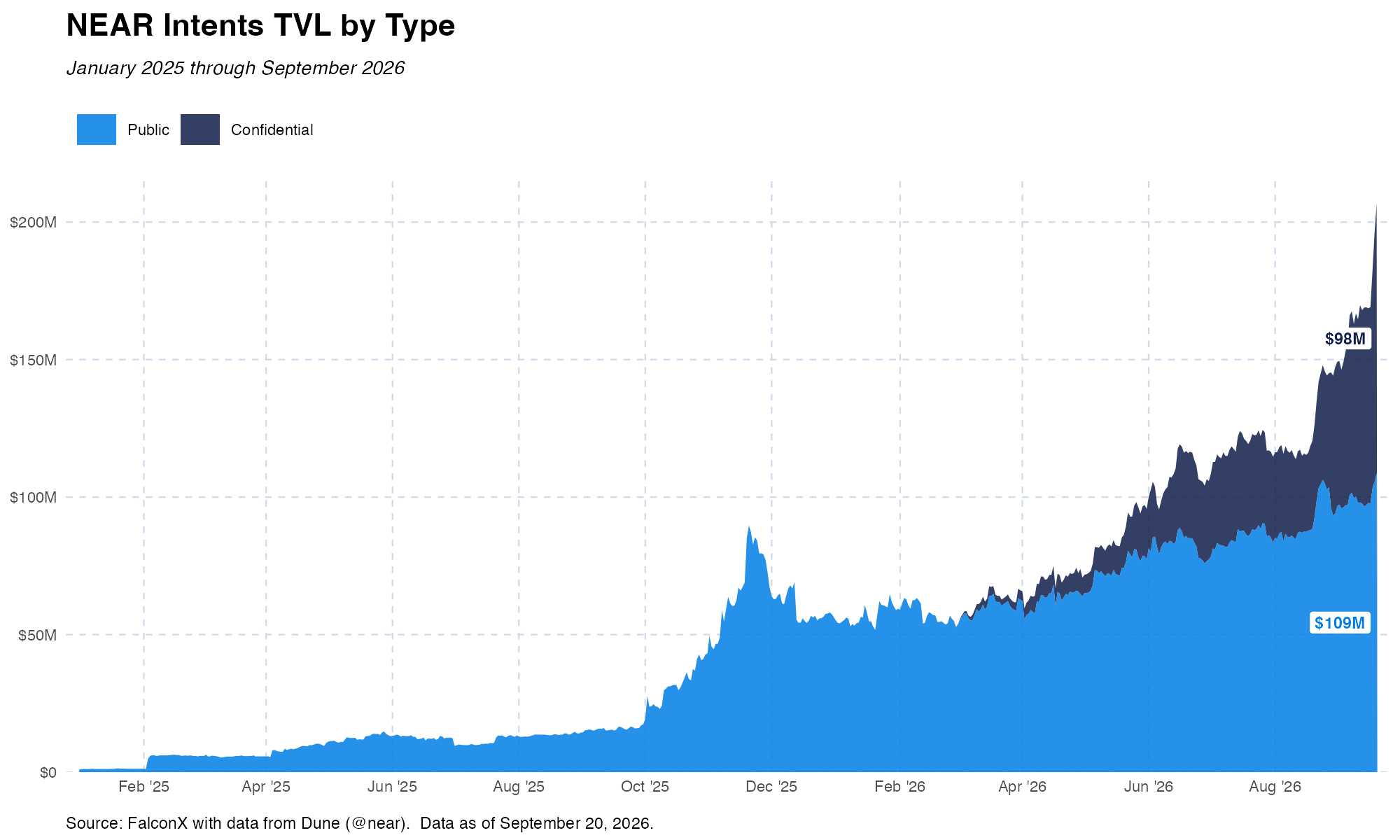
For NEAR, TVL in its Intents (trading) offering has picked up strongly in recent weeks, nearly doubling from last month. The growth is largely driven by ‘confidential’ intents, allowing for private on-chain trading. ZEC is one of the most traded assets on NEAR intents by volume, further attaching it to this narrative. The increased activity has driven a surge in protocol fees as well.
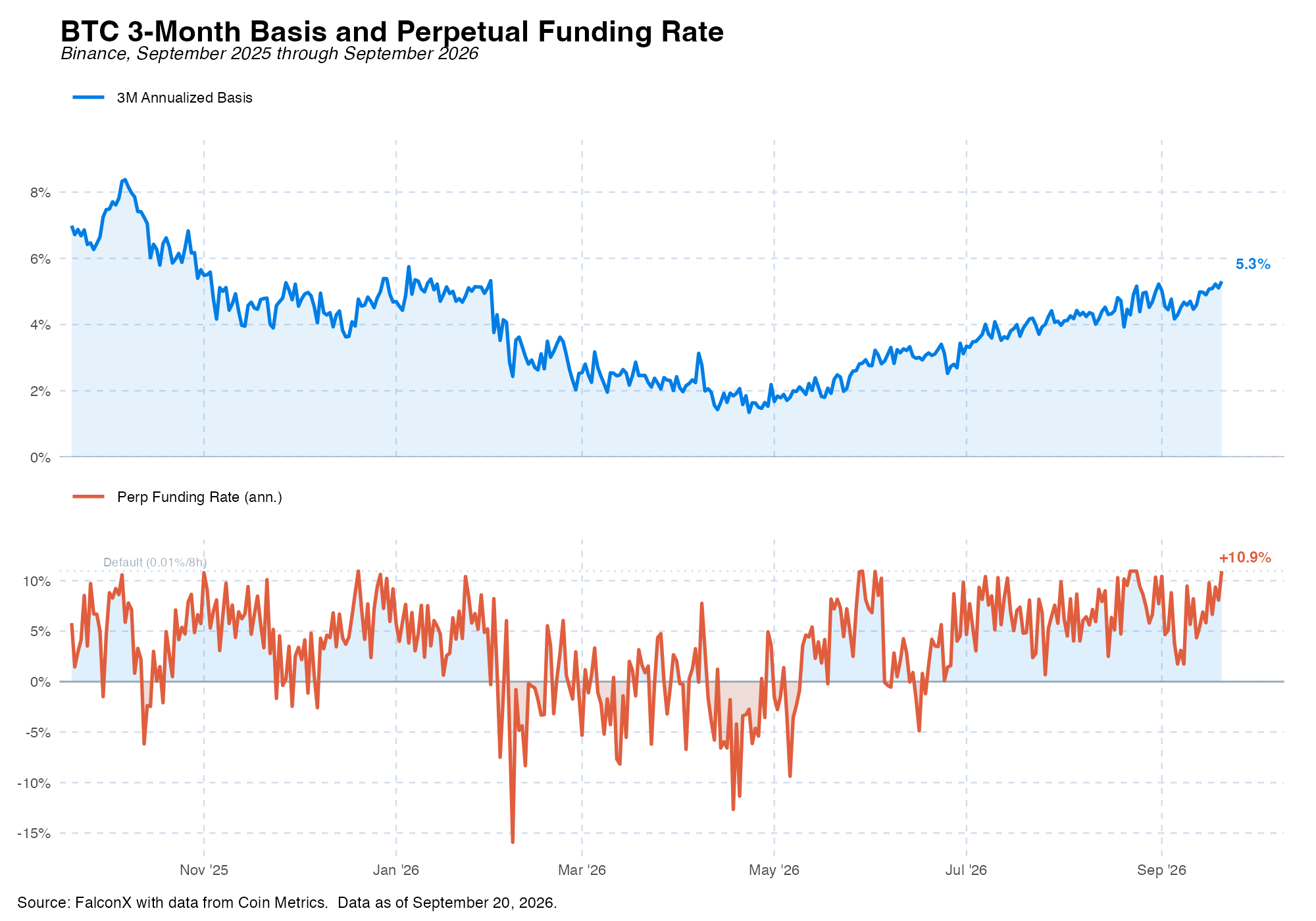
On the DeFi side, Ethena (ENA) seems to be benefiting from expectations for a return of the basis trade. BTC 3-month annualized basis across Binance, OKX, and Deribit has climbed to its highest levels since January this year, per data from Velo, while BTC perpetuals funding has also improved in recent weeks. This indicates traders are paying more to go long, and Ethena stands to benefit by capturing the growing basis through its yield strategies. This may be playing out in real time, where USDe market cap has added approximately $750M (+18%) since August 2026, per data from CoinGecko. It now sits at approximately $4.9B, closer to its $7.5B threshold for its fee switch to be turned on. Over the same period, sUSDe market cap has actually declined $10M, meaning theoretically higher margins for Ethena if the trend sustains. It’s a sign of USDe adoption for money rather than yield (sUSDe). The trend appears to be supported by record daily spending volume on Ethena Pay, which uses USDe.
Finally, apart from the SEC’s innovation exemption, UNI’s relative outperformance may be supported by record revenue the past few weeks, driven by activity on Robinhood Chain, currently annualizing around $186M on a 30D basis per data from Defi Llama. Separately, stock tokens as a share of spot DEX volume on Robinhood have grown to 20%, further cementing UNI as a core participant in tokenized stock developments.
Takeaways
The SEC and CFTC announcements appear to be buoying crypto assets on optimism that key components of Clarity and beyond may be implemented while concrete legislation remains uncertain. Majors are up moderately, while privacy-adjacent and DeFi names are leading the rally.
Disclaimer
This material is for informational purposes only and is only intended for sophisticated or institutional investors. Neither FalconX Limited, FalconX Bravo, Inc., FalconX Delta, Inc., FalconX Golf Pte Ltd., Solios, Inc., Falcon Labs S. DE. R. L., KestrelX, Ltd., KingfisherX Limited, nor Banzai Pipeline Limited service retail counterparties, and the information in this material is NOT intended for retail investors. This material is not (i) an offer, or solicitation of an offer, to invest in, or to buy or sell, any interests or shares, or to participate in any investment or trading strategy, (ii) intended to provide accounting, legal, or tax advice, or investment recommendations, or (iii) an official statement of FalconX or any of its affiliates. Any information contained in this material is not and should not be regarded as investment advice, investment research, debt research, or derivatives research for the purposes of the rules of the CFTC, the Securities and Exchange Commission, or any other relevant regulatory body.
No discussion of a particular company or product shall be considered an endorsement of such company or product. Past performance is not indicative of future results. FalconX, and its affiliated parties, including 21shares, may hold positions in, act as a market maker for, or otherwise have a financial interest in, assets discussed herein, and may benefit from any price movements or transactions involving the subject company. This may change without notice.
Prior to entering into any proposed transaction, recipients should determine, in consultation with their own investment, legal, tax, regulatory and accounting advisors, the economic risks and merits, as well as the legal, tax, regulatory and accounting characteristics and consequences of the transaction. Pursuant to the Dodd-Frank Act, over the counter derivatives are only permitted to be traded by "eligible contract participants" (“ECP”s) as defined under Section 1a(18) of the CEA (7 U.S.C. § 1a(18)). Do not consider derivatives or structured products unless you are an ECP and fully understand and are willing to assume the risks.
Solios, Inc. and FalconX Delta, Inc. are registered as federal money services businesses with FinCEN. FalconX Bravo, Inc. is registered as a Swap Dealer with the U.S. Commodity Futures Trading Commission and is a member of the National Futures Association. FalconX Limited, FalconX Bravo, Inc., FalconX Delta, Inc., Falcon Labs S. DE. R. L., and Solios, Inc. are not registered with the Securities & Exchange Commission or the Financial Industry Regulatory Authority. FalconX Golf Pte. Ltd. is not registered or licensed by the Monetary Authority of Singapore (MAS). FalconX Limited is licensed by the MFSA as a Class 2 Crypto-Asset Service Provider (Regulation (EU) 2023/1114). It is also licensed as a Financial Institution (Cap. 376) exclusively for EMT payment services. FalconX is not a registered security-based swap dealer or broker-dealer with the U.S. SEC or a member of the Financial Industry Regulatory Authority (FINRA). FalconX’s ability to offer trading in tokenized stocks and other products mentioned herein may be restricted in certain jurisdictions.
"FalconX" is a marketing name for the FalconX Group and its affiliates. Availability of products and services is subject to jurisdictional limitations and capabilities of each FalconX entity. For information about which legal entities offer trading products and services, or if you are considering entering into a derivatives transaction, please reach out to your Sales or Trading representative.
.jpg)