Resilience and Recovery: The Pillars Supporting BTC in Q3
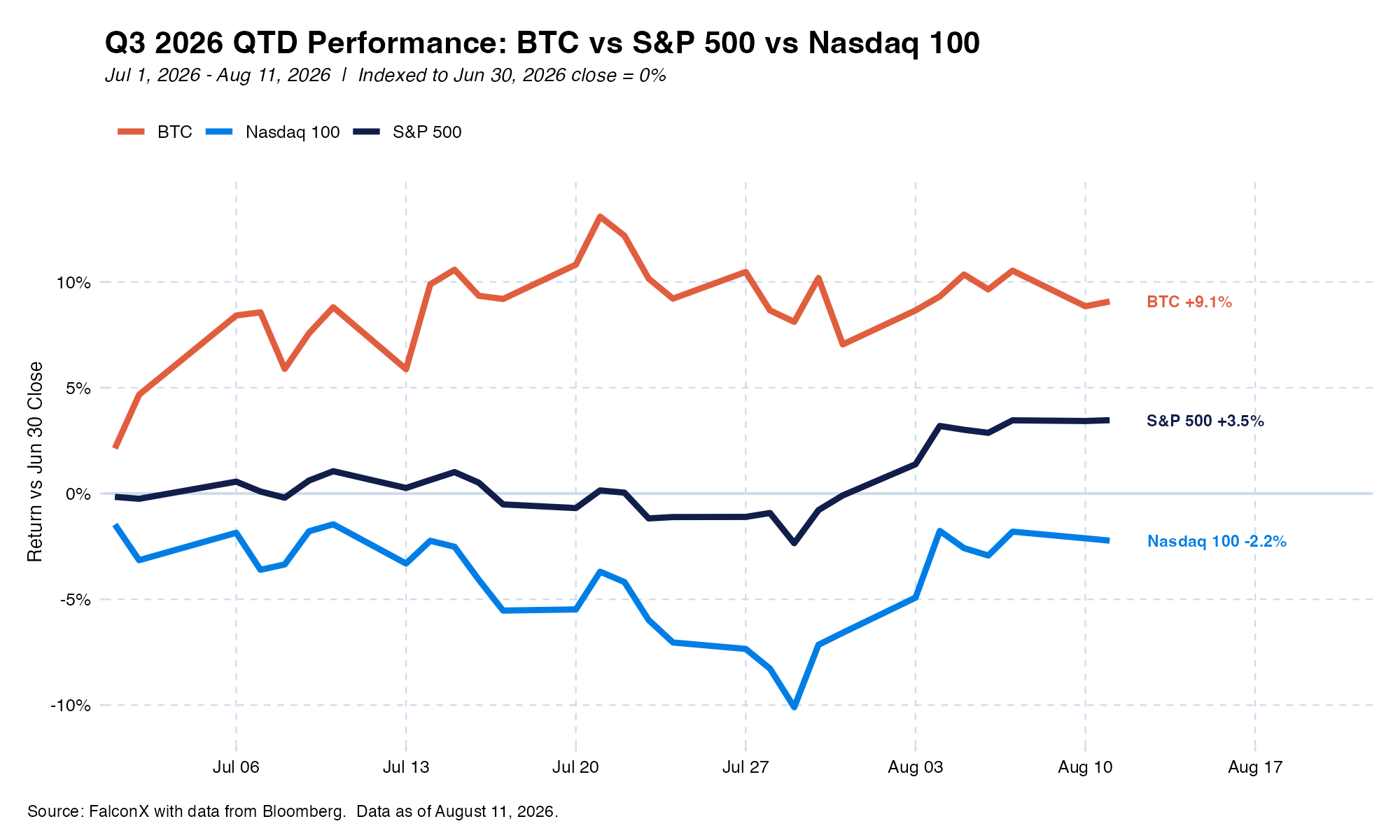
Bitcoin has demonstrated notable strength QTD, rising 9% despite various headwinds, supported by abating concerns over MSTR's capital structure, spot ETF inflows, and signs of long-term accumulation.

Investing in digital assets or tokenized equities, and their respective derivatives, involves a substantial degree of risk. Market prices can be highly volatile and unpredictable. Movements in the market can result in significant, rapid, and potentially total loss of your invested capital. Before allocating capital, you should carefully evaluate whether such investments align with your financial situation, experience, and risk tolerance. For further information regarding potential risks, please refer to the disclaimer below.
BTC has traded up 9% QTD despite several headwinds: falling CLARITY odds, BTC sales from MSTR, the Coldcard hardware wallet exploit, and macro-driven turbulence in equity and credit markets. Its strength may reflect reduced concerns over MSTR’s capital structure, spot buying via ETFs, limited changes in perpetual futures open interest, and signs of BTC accumulation from key cohorts. On the derivatives side, the aggressiveness of put buying has moderated, indicating market participants may not be expecting a sharp move down.
Strategy (MSTR) Concerns Abate
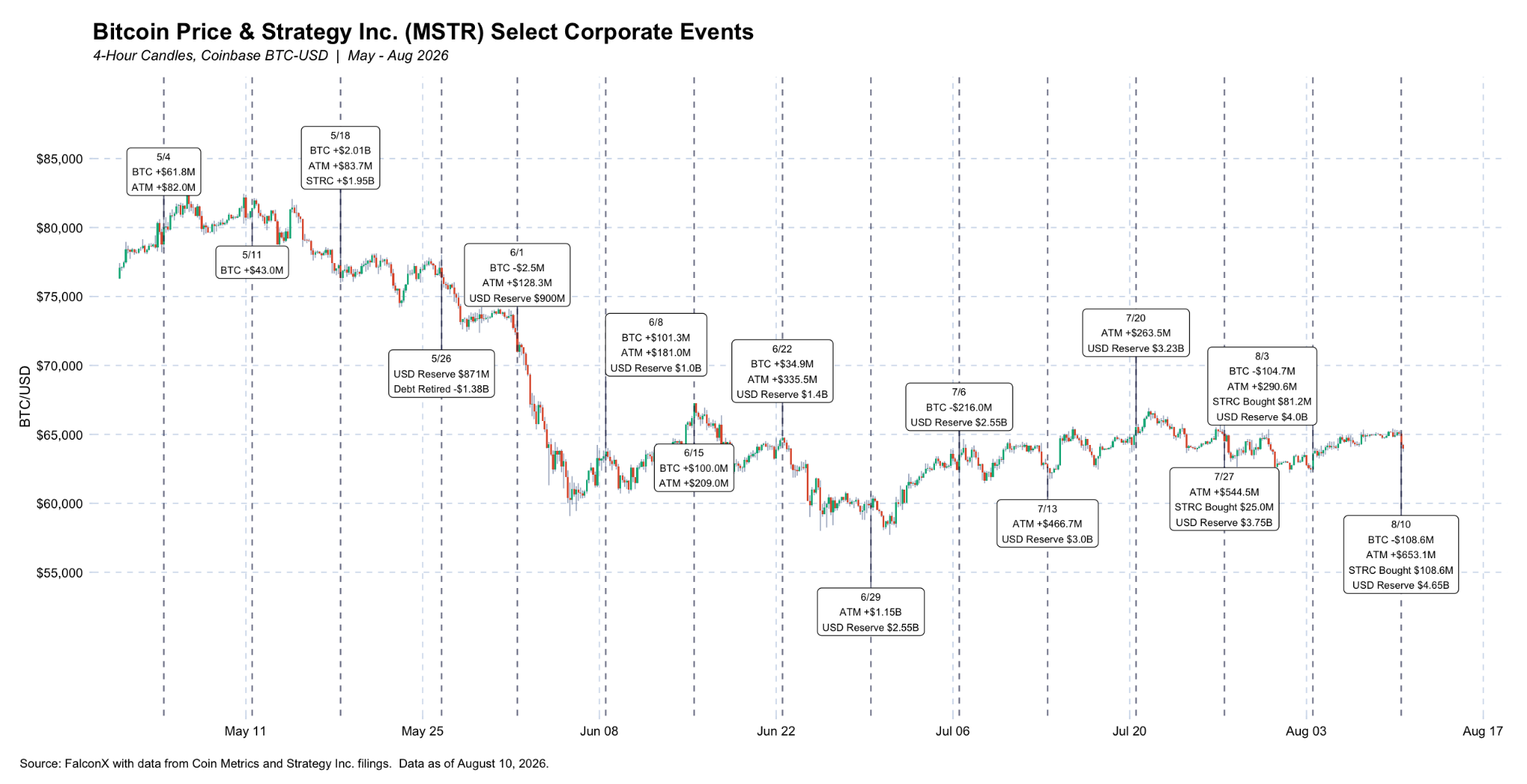
Following BTC’s sharp selloff in June around concerns MSTR may need to sell a significant portion of BTC to service interest and dividend obligations, the initial panic has dissipated into complacency after the company paused BTC purchases and shored up its USD reserve.
In its 2Q26 earnings call on July 30, the company’s management indicated they had learned from the quarter’s challenges and have adapted concrete steps to strengthen their position, such as a stated framework for the USD reserve to cover a minimum of 1 year of interest and dividend obligations, with a goal of 2-3 years of coverage. This commitment may be helping calm the market – MSTR’s USD reserve of $4.65B as of August 9 is its highest ever and provides 2.7 years of coverage.
Strategy has now sold BTC for 2 consecutive weeks, at around $100M/week, and the news of the sales hasn’t driven a BTC selloff. It has used proceeds to repurchase STRC, which has recovered to $95 as of August 11. The prospect of Strategy selling any BTC was unlikely mere months ago, given Saylor’s prior comments, and BTC sold off when it did its initial sale of $2M in Q2. The market has been conditioned to these sales now, with BTC grinding higher despite the cadence of Strategy BTC sales being more frequent and the scale much larger than the sale in Q2.
A couple nuances in the MSTR story make the outlook more positive for BTC going forward.
1) Strategy now has 2.7 years of interest and dividend coverage, versus 1.2 years of coverage in May, when concerns over its capital structure began to spark. This pushes out the timeline for potentially significant forced BTC sales to cover any interest or dividends.
2) MSTR’s mNAV has remained at a premium (1.06x as of Aug 10), per its self-reported metrics, despite the capital structure concerns, suggesting the market still sees MSTR as beta to BTC and worthy of a premium. This indicates MSTR may be able to continue to tap its at-the-market offering program (ATM) accretively, giving it additional flexibility. It most recently tapped its ATM for $653M.
This is partially offset by:
3) MSTR management stating on their recent earnings call that a key goal is supporting the price of their STRC preferred stock back to $99-$100 over time ($95 as of August 11), which could involve further BTC sales to source capital for repurchases. It said it is authorized to repurchase $1B of STRC and $1B of common stock. This could mean further BTC sales to fund these goals.
Funding and OI Trends
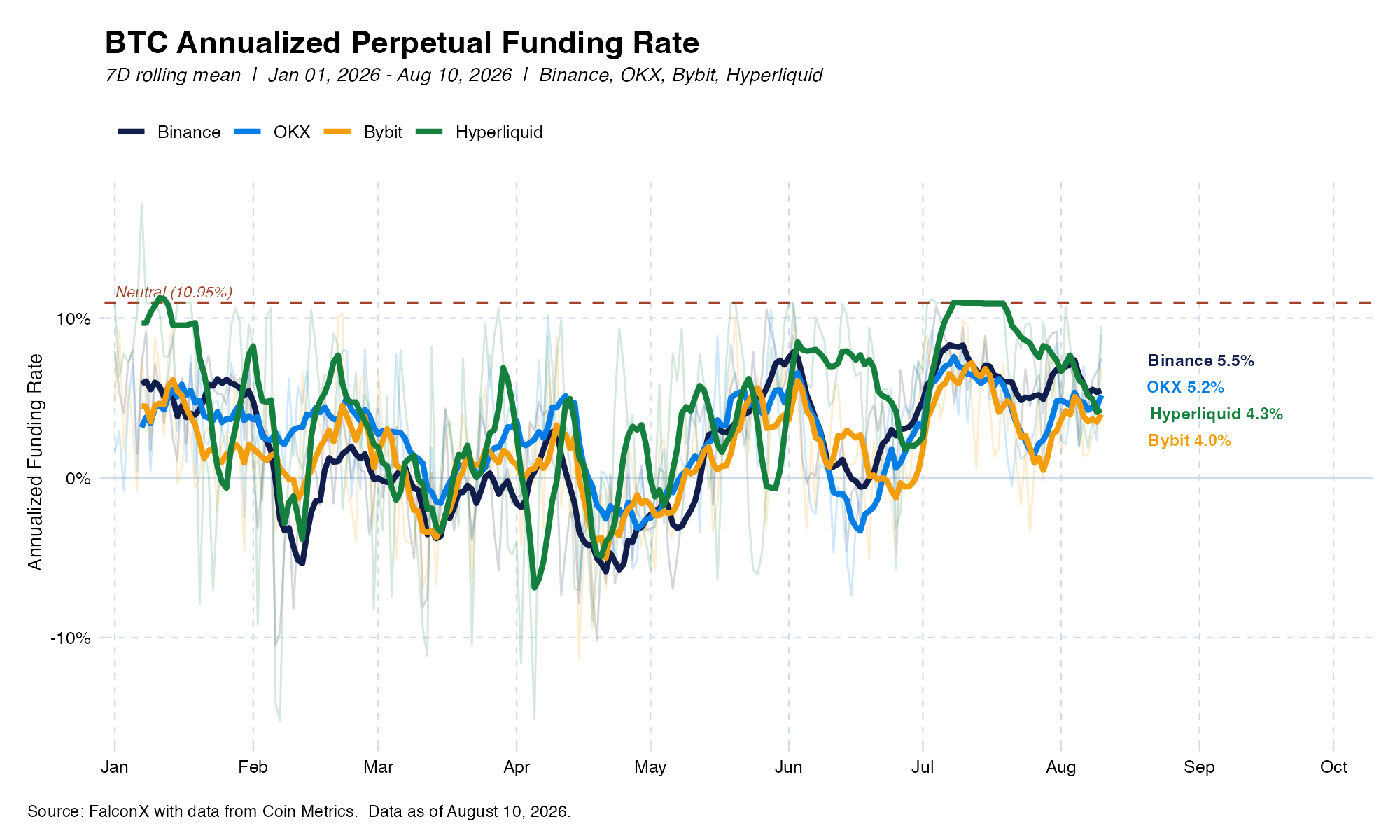
BTC’s move higher QTD does not appear futures driven, with BTC futures open interest (OI) flat in coin terms over the period, per data from Velo. While BTC funding rates remain higher than in June, they are still below neutral, indicating short pressure. These data points taken together suggest the move higher has not been driven by leverage, which may make it more sustainable through potentially less severe long liquidations in case of volatility.
Less Aggressive Put Buying Suggests Downside Concerns Fade
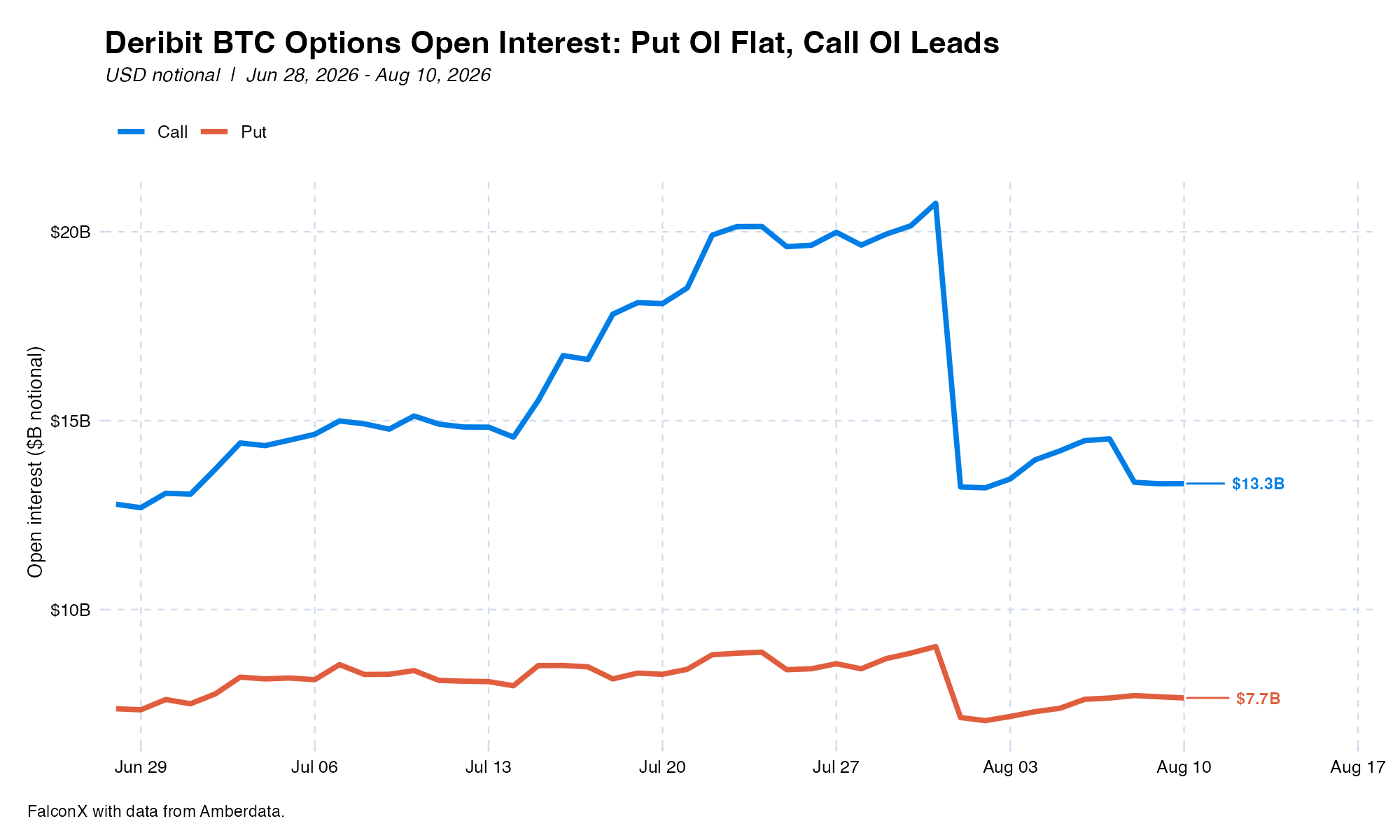
There are increasing signs that traders are paring back expectations of a move down for BTC. Since Q2, Deribit BTC call OI increased more than put OI ($0.5B vs $0.3B, respectively), possibly indicating a reach for upside exposure around CLARITY developments, and keeping the notional put/call book heavily call-weighted (0.57). The overall flattish put open interest ($7.4B to $7.7B) suggests some moderation in put buying aggressiveness. Call OI surged through July, growing 60% from the end of June to a peak of $20.8B on July 31, before rolling off sharply on the monthly expiry.
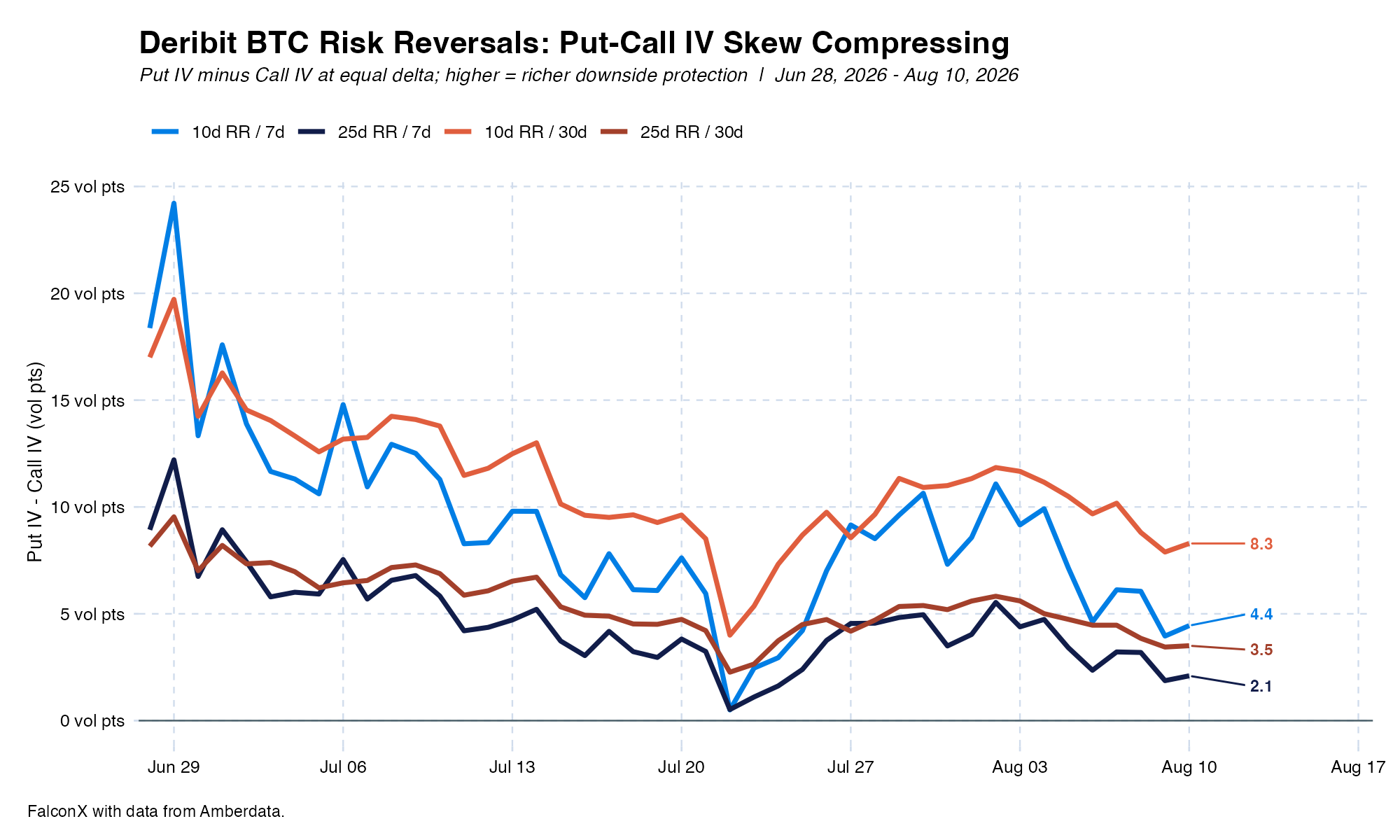
BTC put skew moderated from elevated levels in Q2, as the 25-delta 30D risk reversal fell from +8.2 to +3.5 vol points. Puts still trade at a premium to calls, but the market is paying materially less for downside protection than it was at the end of June. The 7D tenors compressed the most, which may be telling of how rangebound BTC has been.
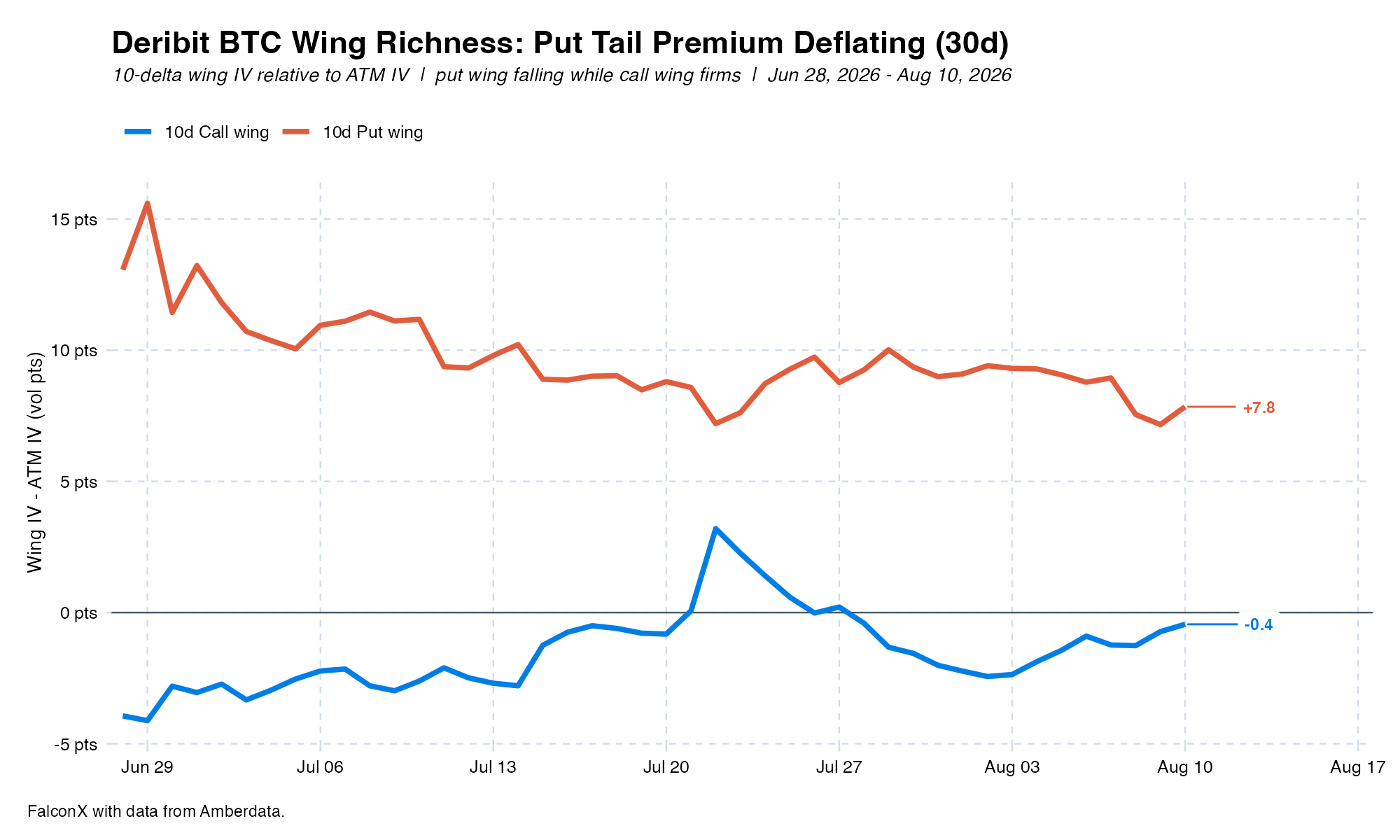
Most of the skew compression was driven by the put wing coming in, while the call wing firmed toward flat. The richness that downside tails carried at the end of June is bleeding out, suggesting decreasing demand for downside protection.
Tether Remains a Consistent BTC Buyer
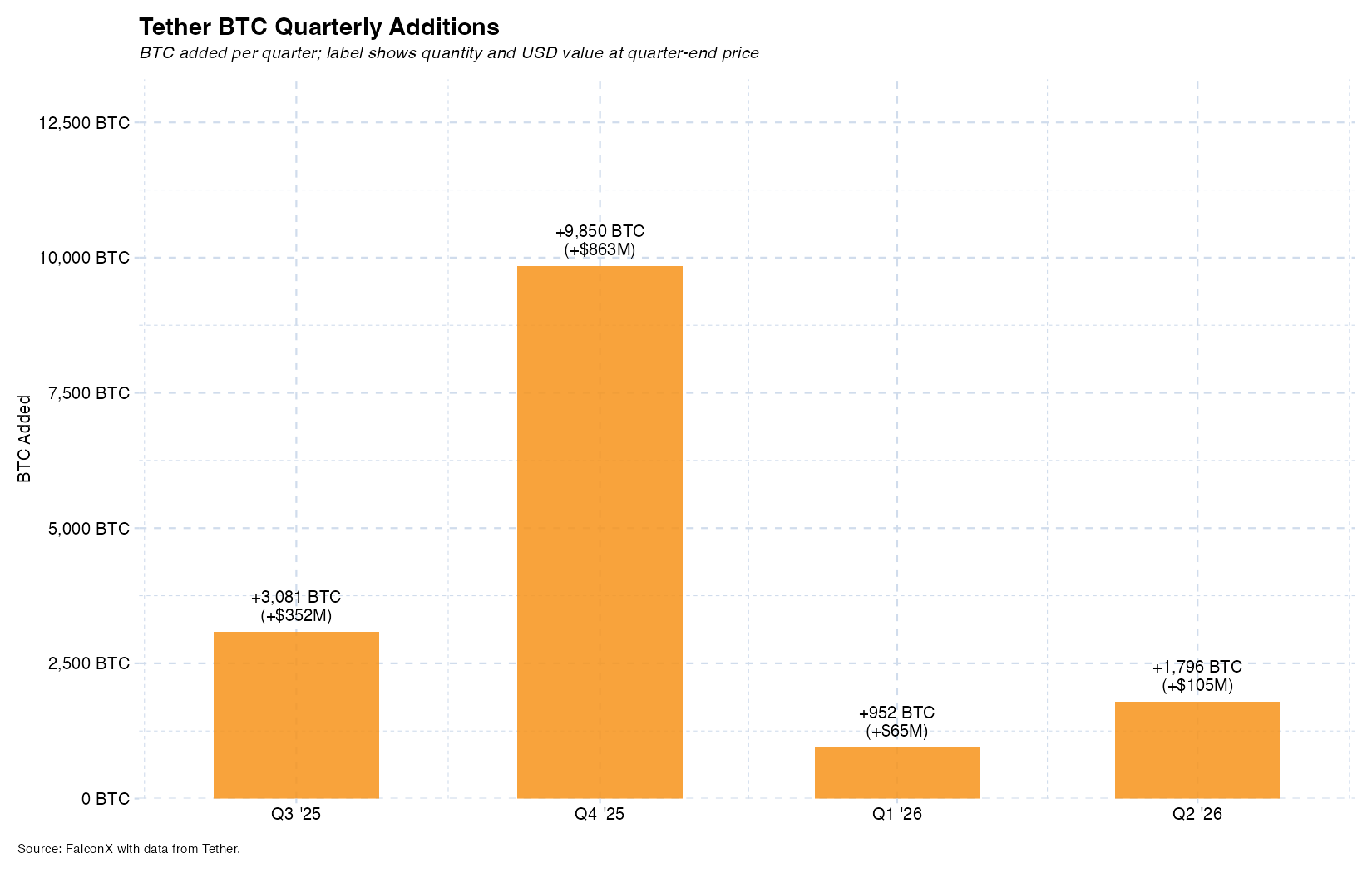
Tether’s 2Q26 attestation report revealed it added nearly 1,800 BTC to its reserves in the quarter, approximately $105M at prices at the end of June. This represents an increase from Q1, but still pales to its BTC purchases last year. The report also showed Tether continued to allocate significantly to gold ($1.8B of purchases in the quarter), suggesting which asset it is favoring for now. Regardless, its move to increase BTC purchases may be instilling some confidence in the market.
Long-Term Holder Supply Hits Record, Draws Down After Wallet Hack
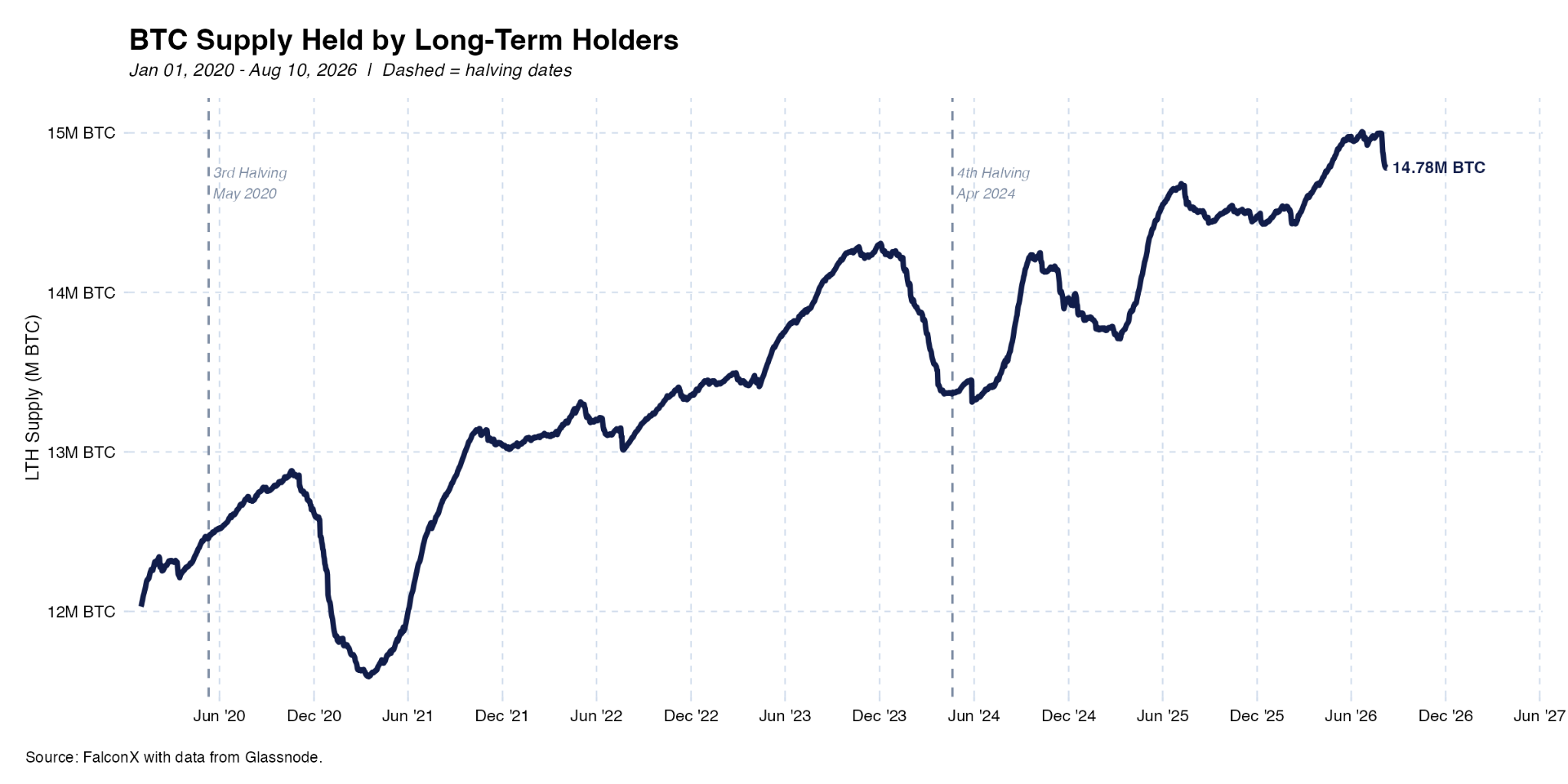
One area of growth in the BTC ecosystem has been the share of supply held by long-term holders (155+ days). According to data from Glassnode, LTH BTC holdings reached records in late June and stabilized there throughout July. However, these holdings dropped at the very end of the month coinciding with the $130M+ Coldcard Wallet exploit, likely reflecting holders moving their BTC to new addresses to secure it.
This broader trend is positive and points to this cohort of holders either standing pat or accumulating in light of the overall BTC drawdown and Q2 volatility, which can help put in a floor.
ETF Inflows Improve From Q2
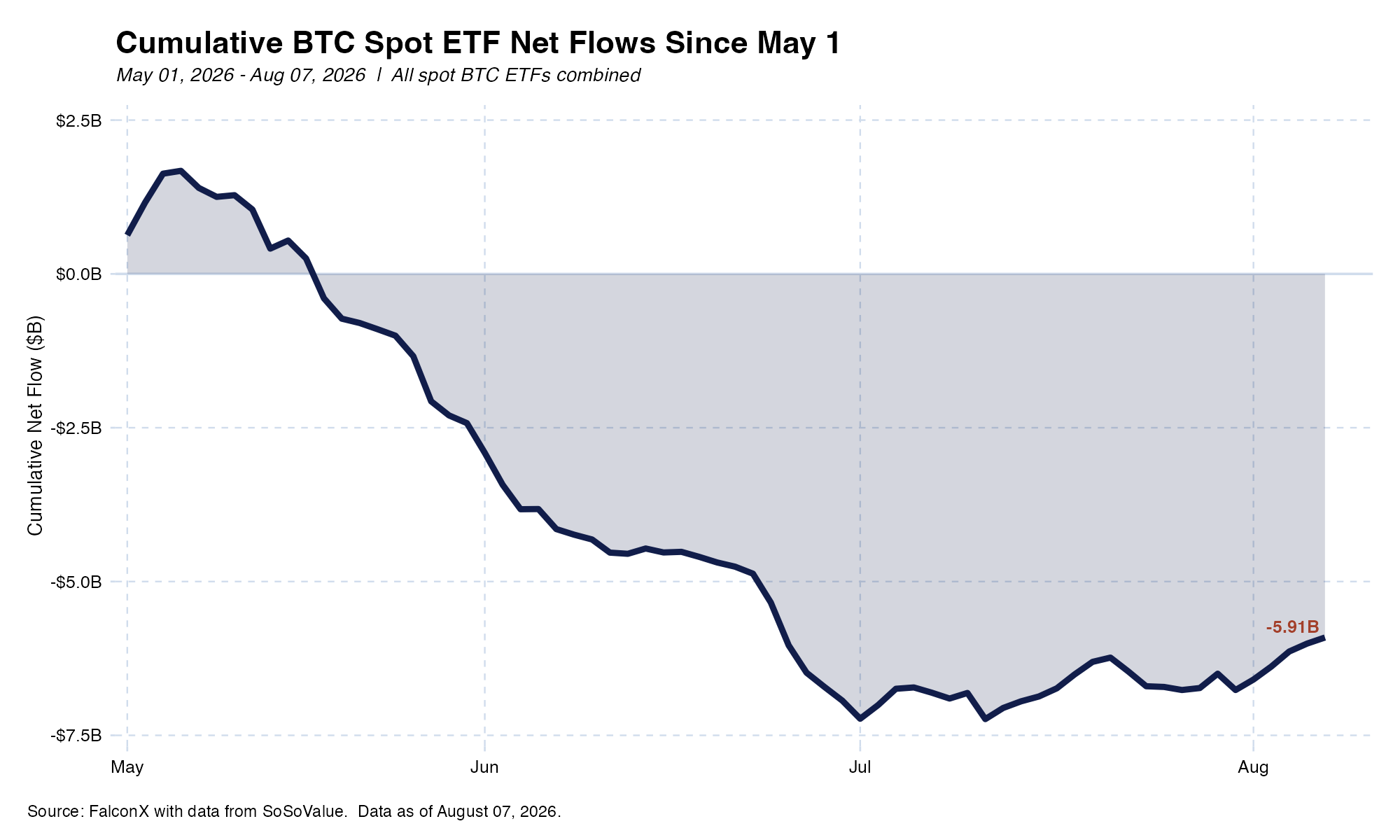
BTC spot ETFs inflected to inflows in July after heavy outflows since mid-May. 4 of the last 5 weeks saw net inflows, with inflows accelerating into August. August has seen 5 consecutive sessions of ETF inflows bringing in $853M (as of Aug 7), per data from Bloomberg. The first week of August posted the highest weekly inflow since April 2026.
MSBT Proves Demand from Wirehouse Channel
The Morgan Stanley Bitcoin Trust (MSBT) continues to see consistent inflows, with cumulative inflows of $460M as of August 7, 2026, according to data from Bloomberg. It saw its second-largest inflow day of nearly $30M on June 30, signaling consistent investor demand despite the volatility in the month.
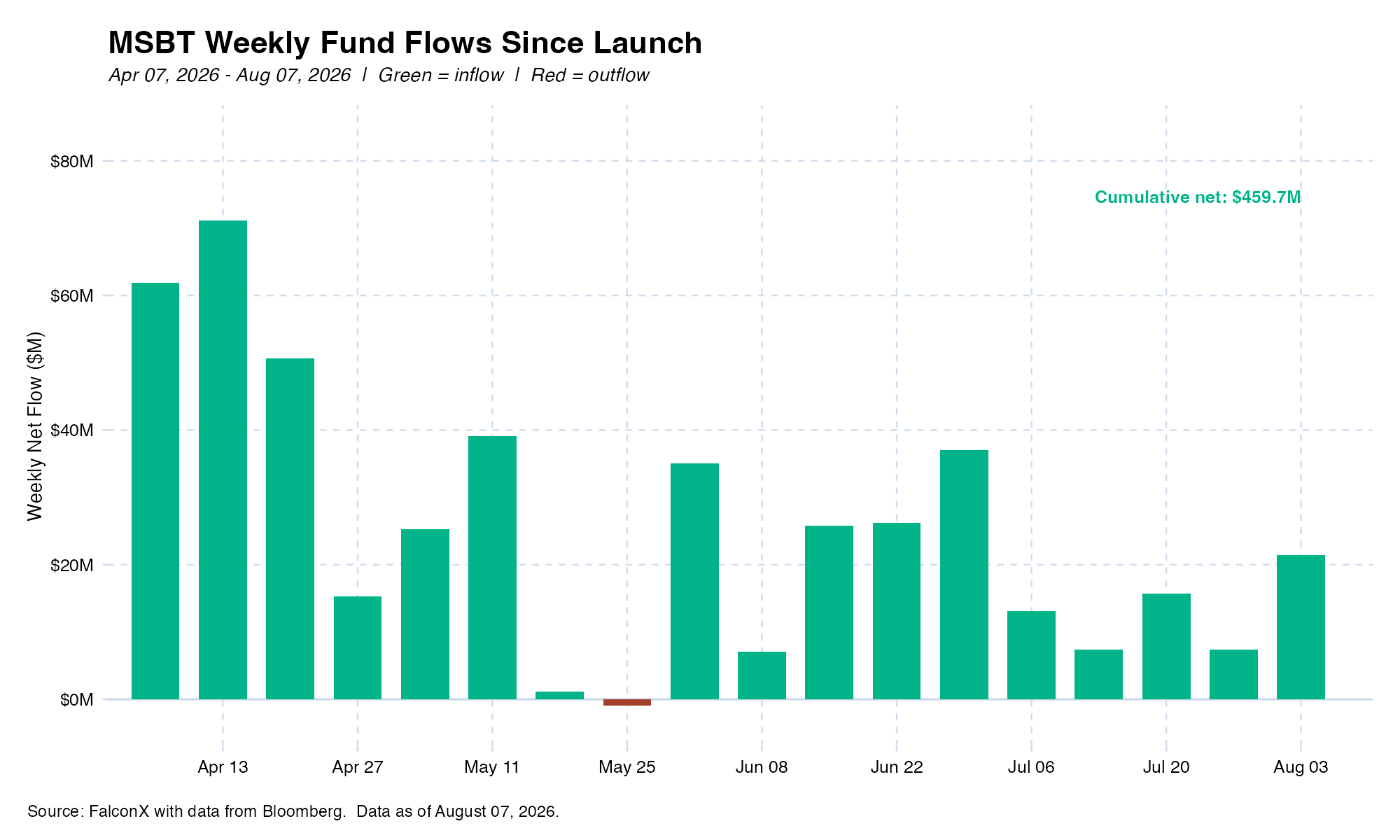
The traction so far could be an early signal of the potential of the wirehouse channel. As more advisors direct demand to these Bitcoin vehicles, they may become a steady driver of flows.
Resilience During Tech Selloff
BTC’s strength may also be due to its outperformance during the selloff in AI stocks in late July. This decoupling from tech stocks may signal seller exhaustion and may position it as an alternative asset where investors can potentially ‘hide out’ from bouts of volatility in equities in the future.
Renewed Macro Concerns
Items on the horizon that may disrupt BTC’s strength are more macro-oriented. One such development is that US treasury yields are climbing. Per data from Bloomberg, the 10Y is at 4.7%, essentially its YTD high, while the 30Y is at its highest since 2007 (5.2%). The moves suggest the market is not convinced inflation and spending has been tamed yet. Rising yields could eventually pressure growth assets such as equities, and any prolonged correction could spill into BTC.
Gold has jumped 9% MTD in August, towards $4,400, as geopolitical tensions as well as interventions in the Yen raise concerns around inflation and monetary policy. It is possible another gold/metals rally could weigh on BTC demand as seen earlier this year. Bloomberg reported ETF demand and central bank buying were drivers behind gold’s latest move higher.
Falling CLARITY Odds
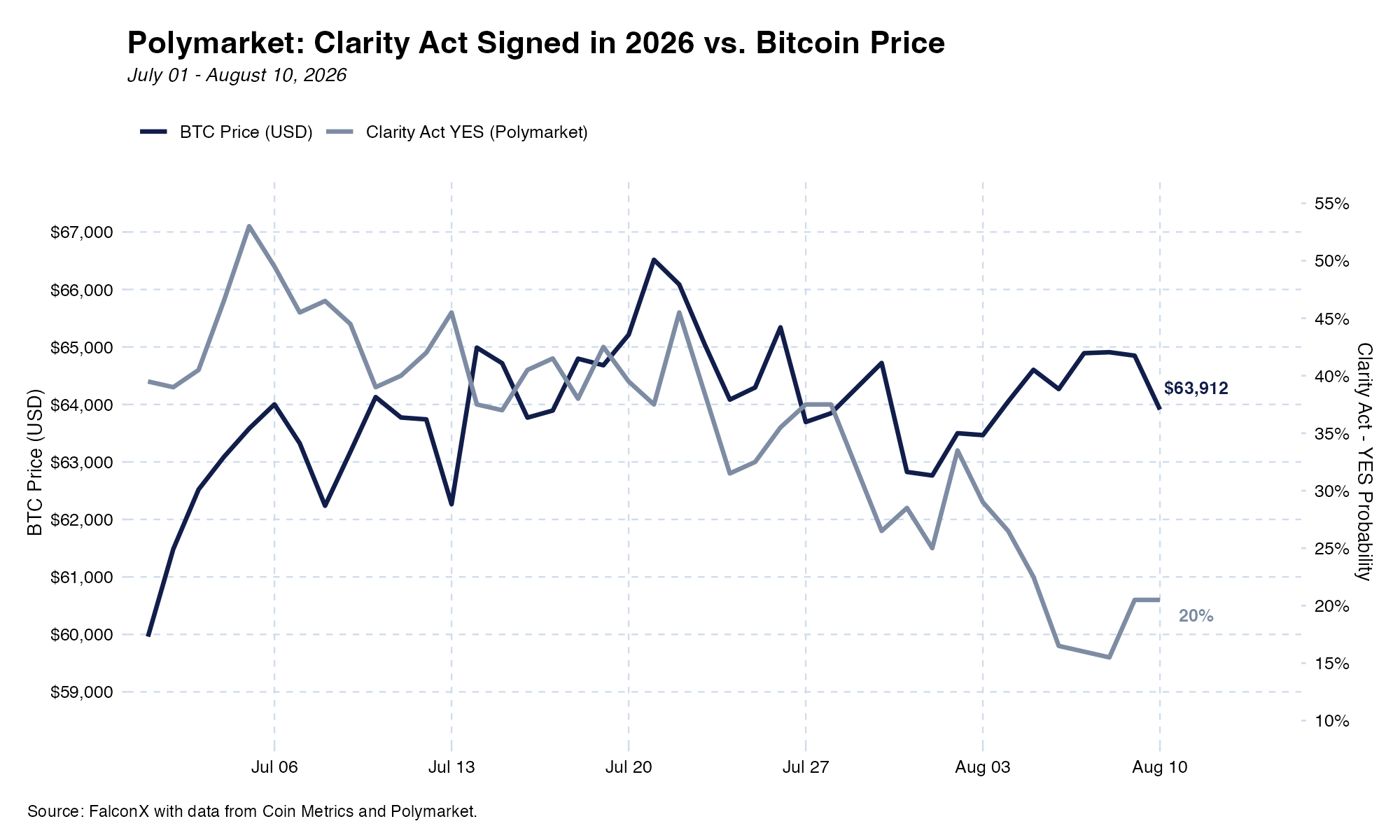
Another potential headwind for BTC is the declining odds that the CLARITY Act will be signed into law this year. Despite negotiations, the Senate did not bring the bill to a vote before the August recess. However, leadership filed a cloture petition on the motion to proceed just before adjourning, setting up a floor vote for September 15. BTC’s resilience amid these setbacks is notable, though it may also reflect expectations that the CFTC and SEC will proceed with regulatory actions independently.
Takeaways
A confluence of factors may be supporting BTC’s strength in Q3 so far. Call activity and less aggressive put buying suggests market participants may be less bearish than before. Timid futures positioning suggests some of the move higher was driven by spot buying, which may be supported by improved spot BTC ETF inflows. Accumulation from long-term holders may also be helping support the price, and dynamics around BTC’s relative outperformance during July’s AI selloff may help it recapture investor interest. Developments that may challenge a continuation in BTC’s rally are more macro-related: the latest gold rally as well as rising treasury yields.
This material is for informational purposes only and is only intended for sophisticated or institutional investors. Neither FalconX Limited, FalconX Bravo, Inc., FalconX Delta, Inc., FalconX Golf Pte Ltd., Solios, Inc., Falcon Labs S. DE. R. L., KestrelX, Ltd., KingfisherX Limited, nor Banzai Pipeline Limited service retail counterparties, and the information in this material is NOT intended for retail investors. This material is not (i) an offer, or solicitation of an offer, to invest in, or to buy or sell, any interests or shares, or to participate in any investment or trading strategy, (ii) intended to provide accounting, legal, or tax advice, or investment recommendations, or (iii) an official statement of FalconX or any of its affiliates. Any information contained in this material is not and should not be regarded as investment advice, investment research, debt research, or derivatives research for the purposes of the rules of the CFTC or any other relevant regulatory body.
No discussion of a particular company or product shall be considered an endorsement of such company or product. Past performance is not indicative of future results. FalconX, and its affiliated parties, including 21shares, may hold positions in, act as a market maker for, or otherwise have a financial interest in, assets discussed herein, and may benefit from any price movements or transactions involving the subject company. This may change without notice.
Prior to entering into any proposed transaction, recipients should determine, in consultation with their own investment, legal, tax, regulatory and accounting advisors, the economic risks and merits, as well as the legal, tax, regulatory and accounting characteristics and consequences of the transaction. Pursuant to the Dodd-Frank Act, over the counter derivatives are only permitted to be traded by "eligible contract participants" (“ECP”s) as defined under Section 1a(18) of the CEA (7 U.S.C. § 1a(18)). Do not consider derivatives or structured products unless you are an ECP and fully understand and are willing to assume the risks.
Solios, Inc. and FalconX Delta, Inc. are registered as federal money services businesses with FinCEN. FalconX Bravo, Inc. is registered as a Swap Dealer with the U.S. Commodity Futures Trading Commission and is a member of the National Futures Association. FalconX Limited, FalconX Bravo, Inc., FalconX Delta, Inc., Falcon Labs S. DE. R. L., and Solios, Inc. are not registered with the Securities & Exchange Commission or the Financial Industry Regulatory Authority. FalconX Golf Pte. Ltd. is not registered or licensed by the Monetary Authority of Singapore (MAS). FalconX Limited is licensed by the MFSA as a Class 2 Crypto-Asset Service Provider (Regulation (EU) 2023/1114). It is also licensed as a Financial Institution (Cap. 376) exclusively for EMT payment services. FalconX is not a registered broker-dealer with the U.S. Securities and Exchange Commission (SEC) or a member of the Financial Industry Regulatory Authority (FINRA). FalconX’s ability to offer trading in tokenized stocks and other products mentioned herein may be restricted in certain jurisdictions.
"FalconX" is a marketing name for the FalconX Group and its affiliates. Availability of products and services is subject to jurisdictional limitations and capabilities of each FalconX entity. For information about which legal entities offer trading products and services, or if you are considering entering into a derivatives transaction, please reach out to your Sales or Trading representative.
.jpg)