Mapping the CeFi Vault Landscape
Major crypto infrastructure providers such as exchanges, brokers, and trading firms are increasingly active in the vault space.

Investing in digital assets or tokenized equities, and their respective derivatives, involves a substantial degree of risk. Market prices can be highly volatile and unpredictable. Movements in the market can result in significant, rapid, and potentially total loss of your invested capital. Before allocating capital, you should carefully evaluate whether such investments align with your financial situation, experience, and risk tolerance. For further information regarding potential risks, please refer to the disclaimer below.
While vaults were initially a DeFi-native innovation, some of the largest crypto exchanges and brokers are now entering the space, driving vault deposits from this cohort to over $2B as of August 31, 2026, per on-chain data. The shift helps validate the market and provides a glimpse of where future vault activity may be headed.
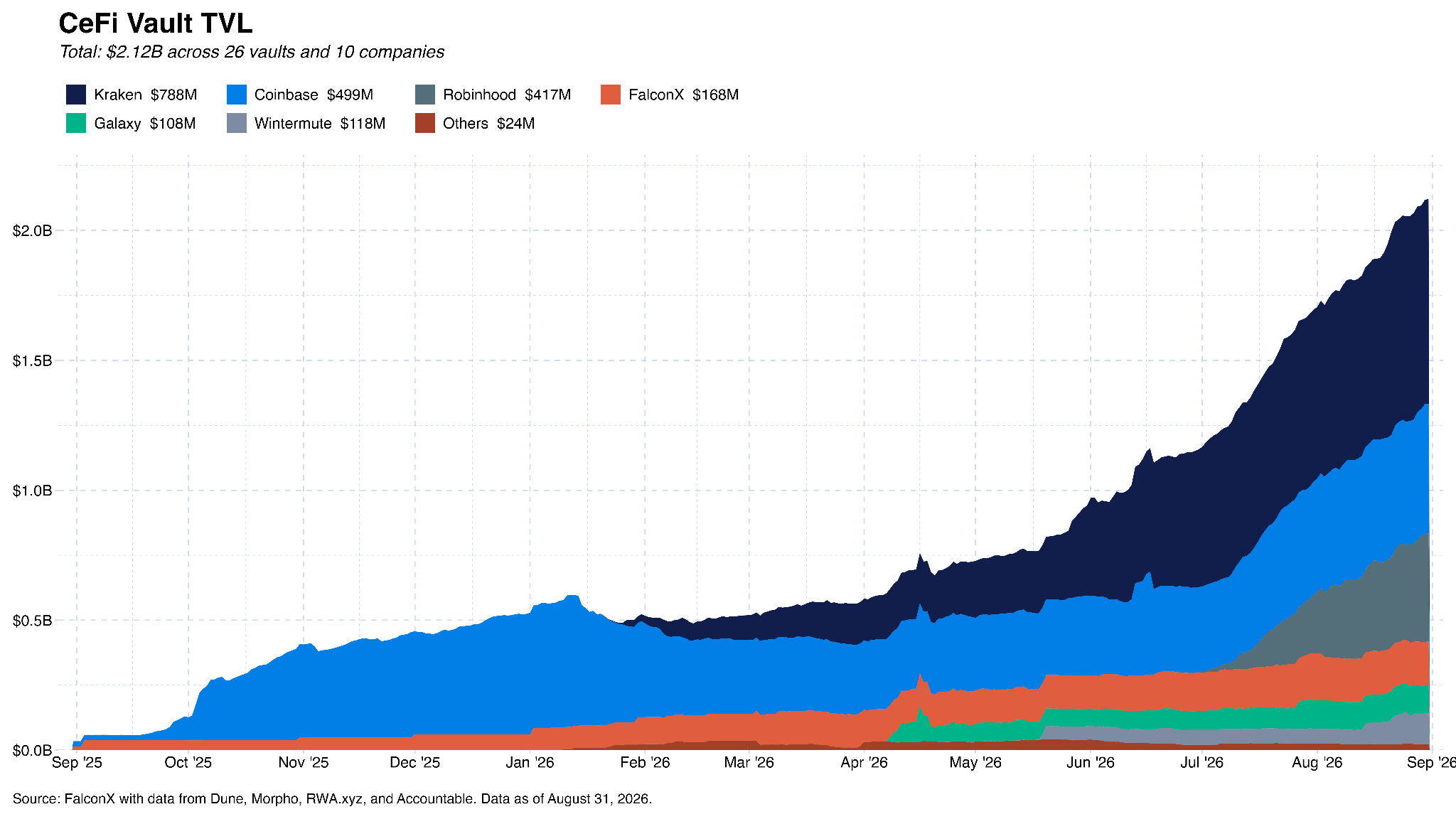
At its core, the surge in vault activity reflects stablecoin growth (supply now $315B vs $169B a year ago, per Artemis) and the corresponding demand for on-chain yield across both retail and institutional cohorts. The secondary driver is enterprise adoption which has led to the creation of some of the largest vaults in the space, thanks in part to large distribution channels.
Key Players and Segments
Crypto exchanges involved in the vault space include Coinbase and Kraken. Crypto prime brokers participating include FalconX and Galaxy, while traditional brokerages include Robinhood. Trading firms involved include Wintermute and Keyrock.
Concurrently, several curators have grown to over $1B AUM: Steakhouse Financial, Sentora, and Gauntlet, according to Castle Labs. They benefit from partnerships with CeFi firms where curation is outsourced but the product is branded and offered in-house.
Vault infrastructure providers include Morpho, Veda, Pareto, and Accountable.
Centralized exchanges tend to offer vault offerings through their Earn programs that are geared towards retail, while trading firms can leverage their vaults to broaden access to higher-yielding strategies to their institutional client base.
Overall, these products tend to be focused on asset management: providing a yield strategy and earning management and performance fees on it. For some firms, there can be further synergies, such as using the vaults to support or feed into other products. However, given how nascent the vault space is today, many of the vaults offer low or no fees to help support adoption.
Coinbase
Coinbase has two vault offerings, both integrations of Steakhouse-curated USDC vaults on Morpho. Considering these vaults are publicly accessible, Coinbase appears to be positioned as a distribution partner for now (though may have off-chain arrangements with Steakhouse and Morpho).
It launched its first Prime USDC vault offering in September 2025, while its High Yield USDC vault went live in June 2026. Steakhouse Financial is the curator for both vaults (it describes itself as the exclusive vault partner for Coinbase’s DeFi Lend integration), meaning it manages the deployment of the strategies.
The Prime vault allocates USDC into overcollateralized lending markets on Morpho on Base, concentrated in blue-chip collateral pairs (cbBTC, cbETH, WETH, wstETH) with loan-to-value (LTV) ratios between 77%-86%. It is intended to be relatively conservative, only lending against very liquid collateral.
Its High Yield USDC vault launched in partnership with Ethena. Users deposit USDC which is deployed into similar blue-chip strategies as well as those using Ethena assets (sUSDe, USDe). Specifically, the vault deploys depositor USDC into overcollateralized lending markets on Morpho on Base, anchored in Coinbase-issued collateral (cbBTC, cbETH, cbXRP) alongside a productive stablecoin position (USDe) with loan-to-value ratios between 62.5%-91.5%. Steakhouse describes the vault as adding sUSDe exposure to the blue-chip core collateral. jitoSOL is also listed as a potential Morpho market it can deploy into.
Ahead of its Ethena vault offering, Coinbase announced in June 2026 that it serves as Ethena’s primary custodian, wallet provider, and perpetuals venue.
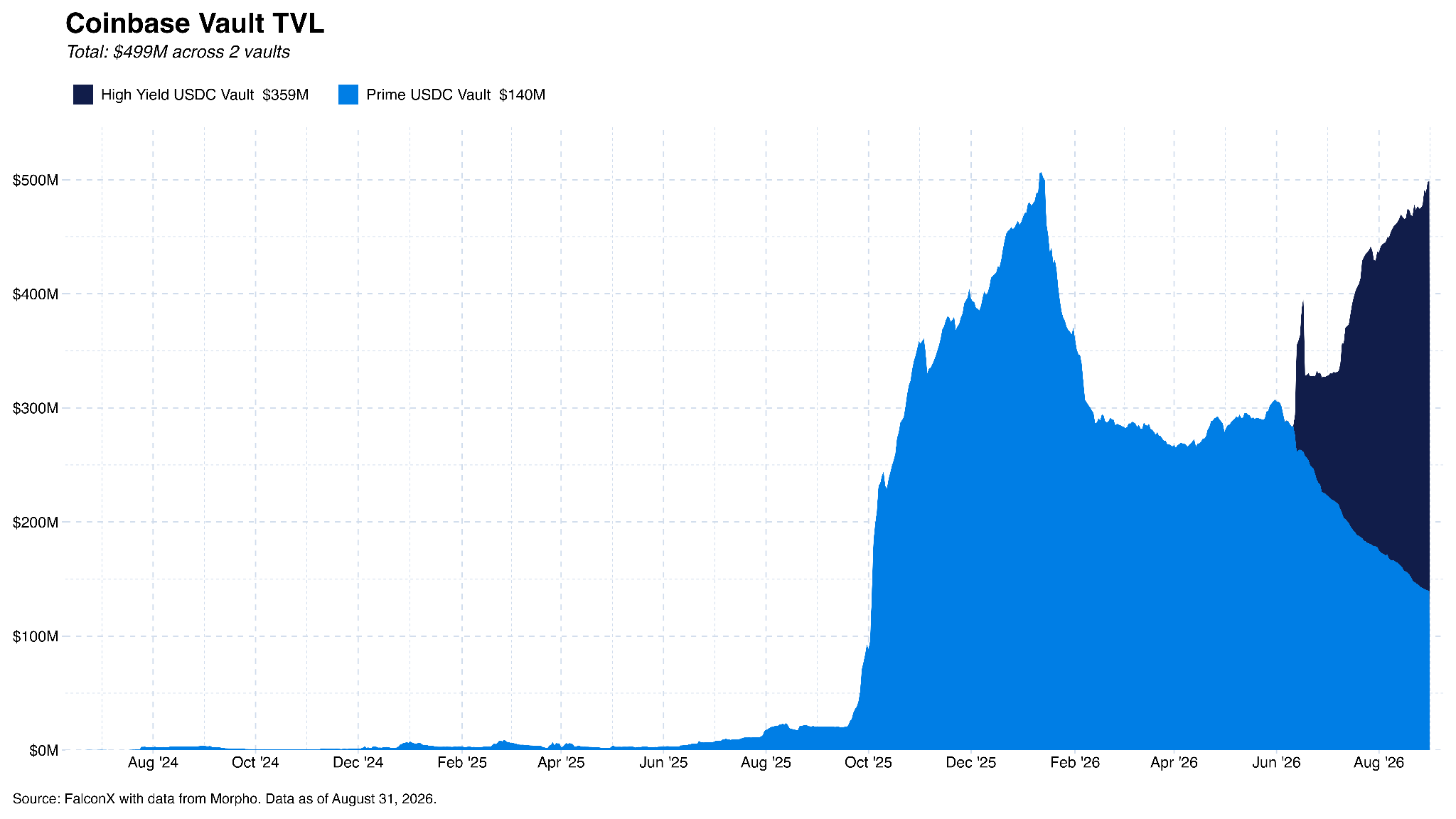
As of August 31, 2026, the High Yield vault had $359M USDC deposits, while the Prime vault had $140M. The Prime vault hit a high of approximately $500M in January 2026. However, based on flows and total value locked (TVL), the High Yield vault appears to have cannibalized the Prime vault, flipping it in size in mid-July.
Morpho markets target 90% utilization of deposits, highlighting liquidity risks in case of a spike in withdrawal demand during market stress events. According to Steakhouse, however, Prime markets tend to be fully liquid even in these events, potentially reflecting the quality and liquidity of the collateral.
The vault offerings build on Coinbase’s prior borrow integrations with Morpho, which allowed users to borrow against BTC and ETH, therefore now enabling users to lend and borrow. These borrow offerings via Morpho have seen steady growth over time, with active borrows sitting at a record high of $1.4B as of August 31, 2026, per data from Morpho. Coinbase charges an origination fee of up to 2% for borrows facilitated through its Morpho integration.
These products are available via Coinbase, such as the Coinbase app, and leverage Coinbase’s Smart Wallet tooling to interact with Morpho on Base in a non-custodial manner. Coinbase One subscribers may be eligible to receive boosted rewards in the form of MORPHO tokens and USDC.
Some advantages of these products that Coinbase highlights are their self-custodial nature, the ability for instant deposits and withdrawals, as well as accruing yield in real time. However, vaults also come with protocol risk (smart contract exploits), bad debt risk (collateral declines in value), and liquidity risk (utilization prevents withdrawals).
As of August 31, the Prime vault showed a native APY of 3.2%, and was nearly entirely allocated into BTC-backed loans. The High Yield vault was yielding 2.6% natively as of August 31, with most of the vault allocated into USDe-backed loans, per data from Morpho. Both vaults have a 25% performance fee that accrues to Steakhouse. Coinbase has advertised higher yields for the vaults, such as 7% for the High Yield vault for Coinbase One members, with the difference reported to come from boosted rewards in MORPHO tokens.
In contrast with its Morpho borrow integration, where it charges loan origination fees, Coinbase monetizes its vault integrations through receiving some of the performance fee from Steakhouse, per Decrypt. Moreover, it stands to benefit from providing users a reason to keep USDC on its exchange and the broader crypto ecosystem, thanks to its arrangement with Circle where it receives USDC-related treasury income. Additionally, there are platform effects where users interacting with the ‘Earn’ product activate on the ‘Lend’ product down the road. This enables Coinbase to provide both sides of the borrow and lend demand for these products.
Kraken
Kraken offers vaults as part of its ‘DeFi Earn’ offering, leveraging vault provider Veda on the backend and Sentora for strategy design and risk management. As of August 31, it had $788M deposited across 4 vaults: boosted USDC ($44M), balanced USDC ($23M), advanced strategies USDC ($255M), and advanced strategies BTC ($465M). The USDC vaults reflect different levels of risk/return:
- Balanced: Lower Risk
- Boosted: Moderate Risk
- Advanced Strategies: Higher Risk/Return
The Advanced Strategy vault uses protocols such as Euler, Morpho, Curve, and Aave, per Sentora. The vault engages in lending, leveraged looping, and liquidity provisioning in DEXes. A key focus is on ensuring no lockups for withdrawals, although the vault has a one-day withdrawal period to help manage slippage on large exits.
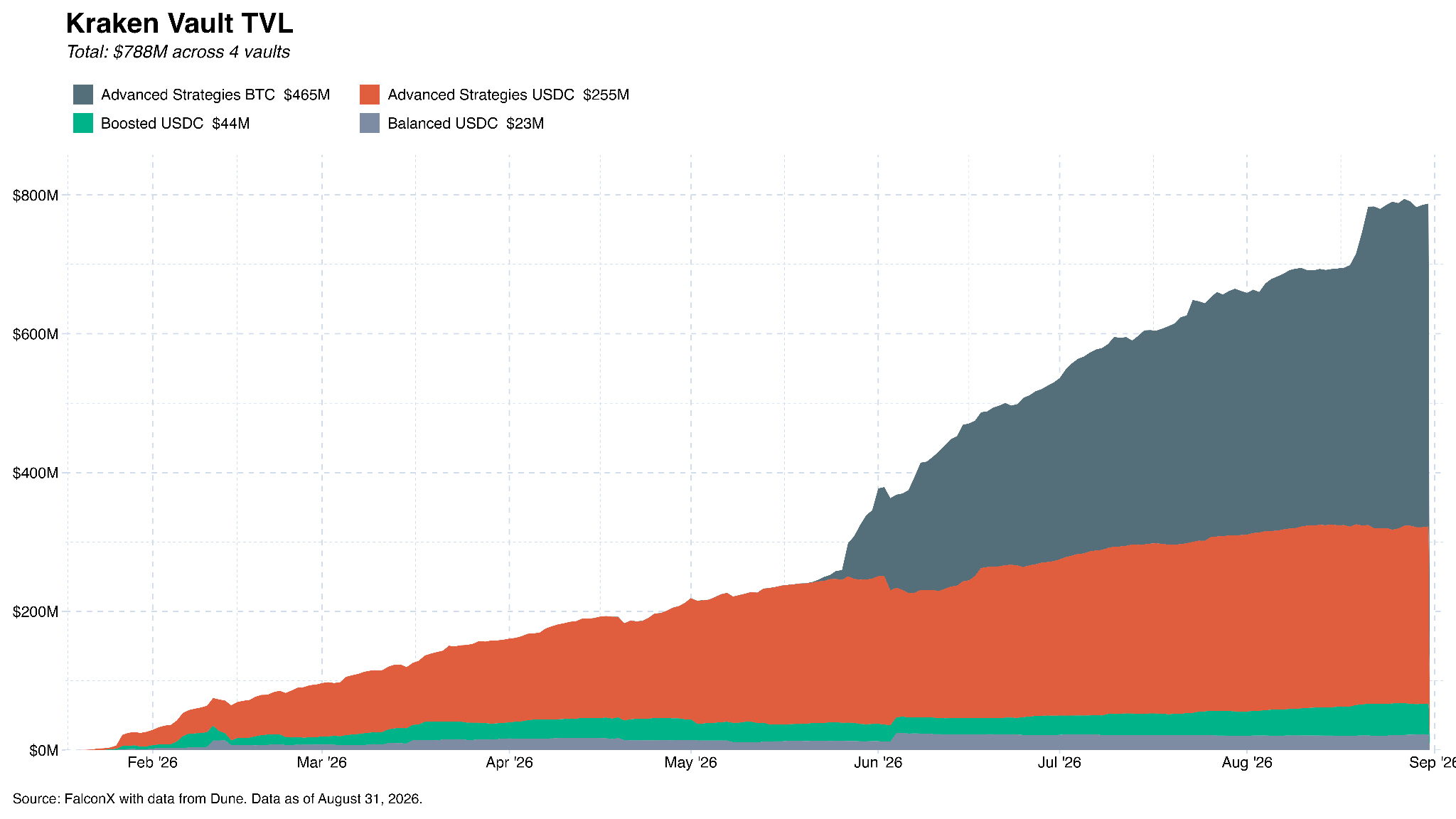
Kraken first rolled out its USDC vaults in January 2026 and announced its BTC vault in May 2026. The BTC offering is powered by Veda, with strategy design and risk curation by Sentora. It allocates to protocols such as Aave, Morpho, and Tydro. BTC is wrapped to kBTC and deposited to the Veda vault on Kraken’s Ink L2. Stablecoins are borrowed against it and used in DeFi strategies, with yield converted back to kBTC to provide BTC yield.
The vaults are not permissionless. They are offered exclusively through Kraken interfaces. When users move to deposit into the vaults, Kraken creates self-custodial Privy wallets that then transfer the funds into Veda vaults, which support whitelisting and transfer restrictions.
Kraken’s vaults are unique in that they deploy across chains, thanks to Veda infrastructure. For example, its vaults could take deposits from the vault on Ink and deploy them into Aave on Ethereum mainnet. This lets Kraken bootstrap liquidity on its own L2 while still accessing deeper liquidity and yields on Ethereum. However, it appears that a large portion of Kraken vault deposits ultimately end up in Morpho, per data from Dune.
The vaults charge a 25% performance fee. Kraken reportedly receives 80% of this, while Sentora and Veda receive 15% and 5%, respectively.
As of mid-August, the USDC vaults were yielding 5-10%, per data from Dune, while the BTC vault was closer to 3%. The yields are reportedly heavily dependent on Merkl incentive farming, contributing a significant portion of yield.
Robinhood Earn
As part of its Robinhood Chain mainnet launch in July 2026, Robinhood rolled out its on-chain Earn program, available through the main Robinhood app. Users can lend USDG through a vault powered by Morpho and supported by Steakhouse (curator), Ethena, Spark, and Maple. The Earn vault is the Steakhouse USDG vault, which does not have any performance or management fees as of writing. It targets an APY of 7%, subsidized by Merkl rewards.
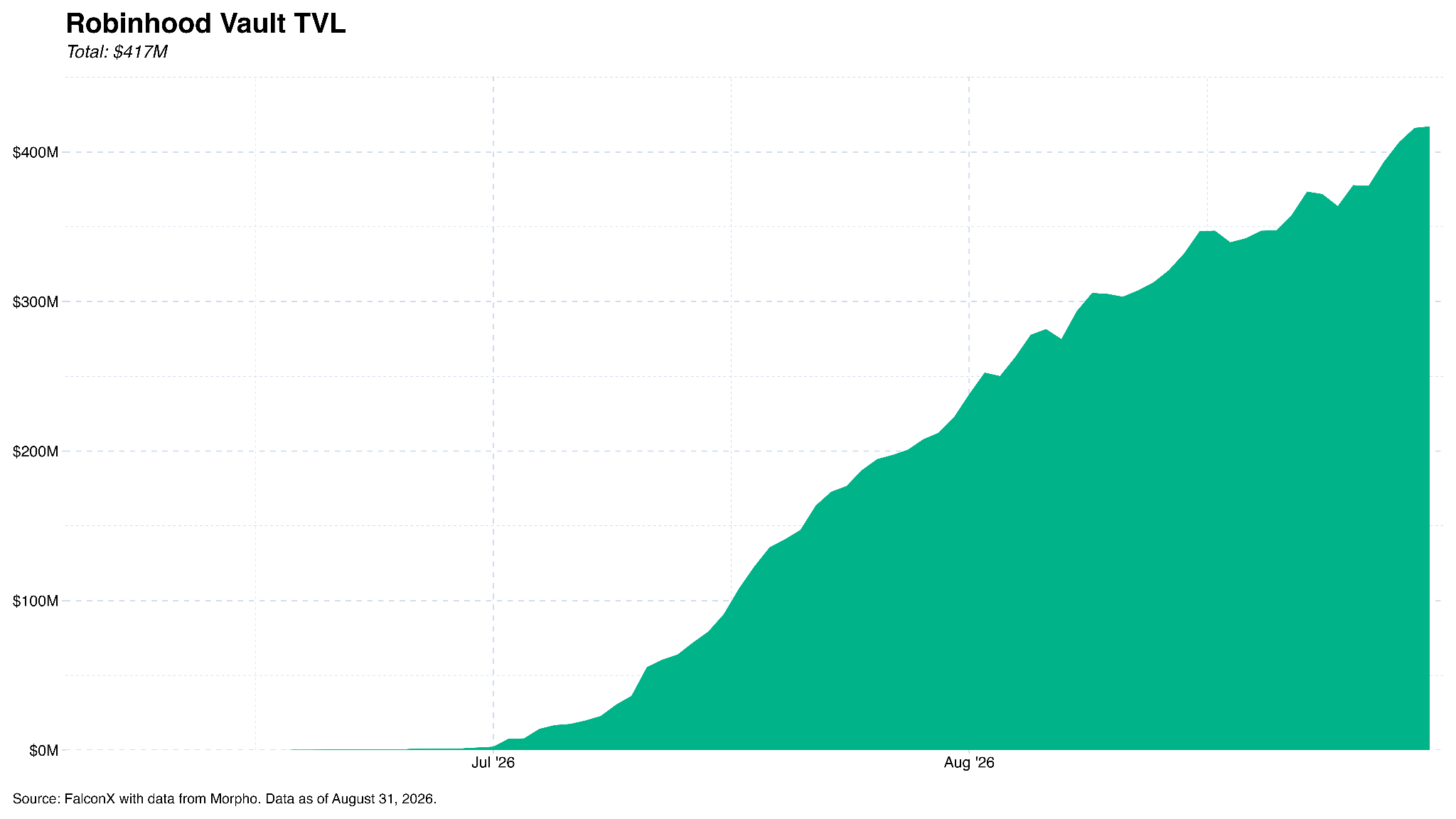
Deposits in the Steakhouse USDG vault have climbed to approximately $417M as of August 31, 2026, showing consistent depositor demand since launching. This vault is now the single-largest stablecoin-denominated Earn program vault by TVL and the third-largest vault on Morpho.
Notably, the Robinhood Earn product is insured through Lloyd’s of London and RELM for losses related to a cyber event or smart contract exploit, where if a covered event occurs, Robinhood (as the policyholder) may use insurance proceeds for loss mitigation. The caveat here is that the covered limit was not published, still leaving some uncertainty as the vault scales. However, Robinhood stated in its chain announcement presentation that it could be one of the largest, if not the largest insurance programs across the crypto industry.
FalconX Credit Vault
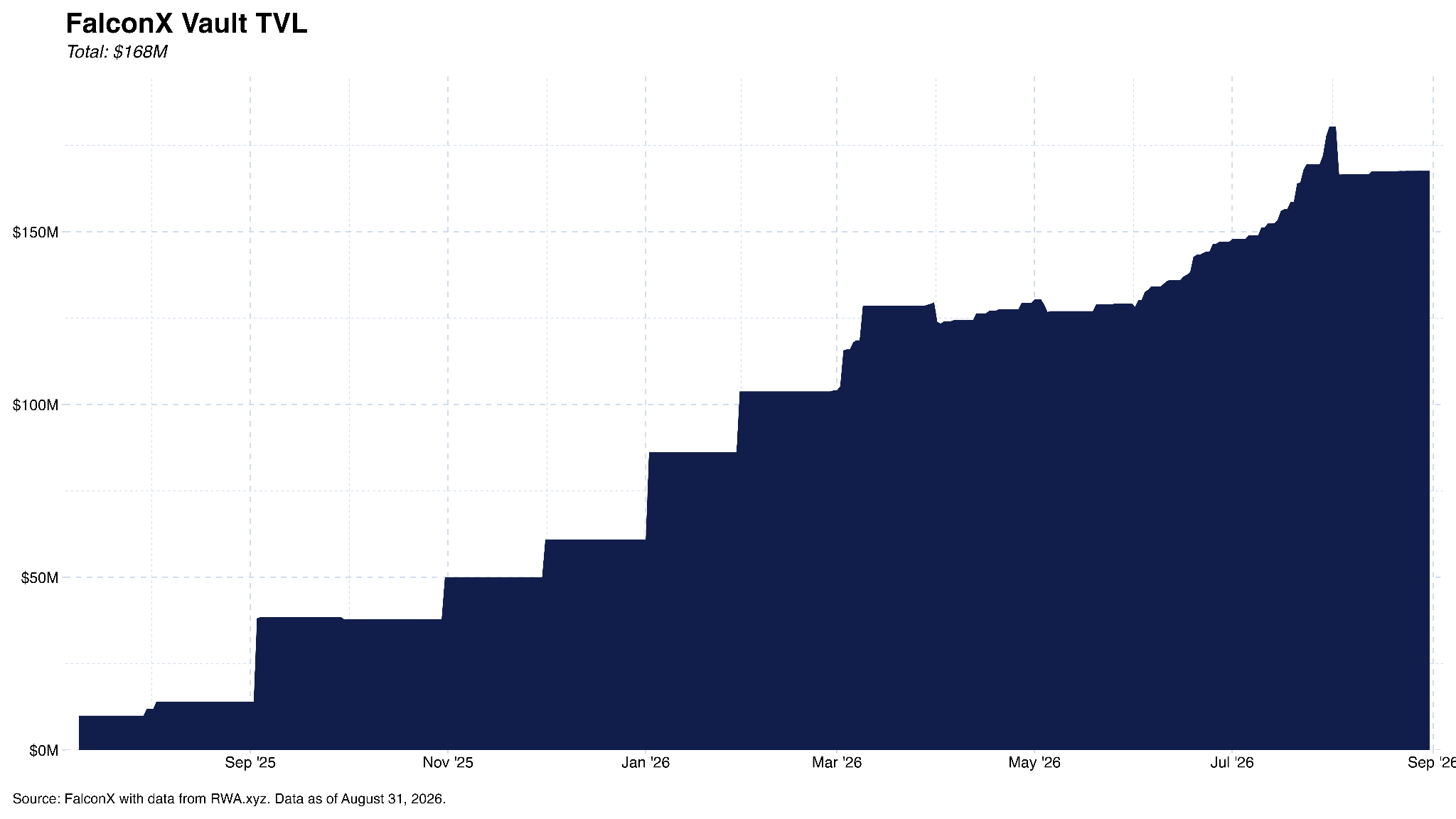
Crypto prime broker FalconX operates a vault in partnership with M11 (curator) and Pareto (vault infrastructure and platform). FalconX’s institutional lending desk uses the vault capital to extend overcollateralized credit to institutional clients such as hedge funds and trading firms. The FalconX Credit Vault launched in March 2025 and has grown to approximately $168M TVL as of August 31, 2026.
Allocators can deposit USDC into the Pareto vault. The credit vault operates on monthly cycles, during which eligible users can request deposits and redemptions for the next cycle. Interest accrues through the cycle and is reassessed for the next period at cycle end via a structured Loan Notice. Returns are distributed monthly on-chain.
The vault lends to OspreyX 2024-A Limited, a Cayman SPV designed to separate investor capital from FalconX's corporate balance sheet. The structure is supported by real-time collateral monitoring, automated margin management, and independent oversight from M11 Credit, acting as Administrative and Collateral Agent. Falcon Labs Ltd serves as the designated Collateral Manager. Moreover, FalconX provides a first-loss capital contribution.
For a deep-dive into the FalconX vault, please refer to our piece here.
Galaxy
Financial services and infrastructure firm Galaxy Digital is involved in the vault space as a curator as well as a borrower. In July 2026, it launched a vault curation offering built on Morpho, accessible through Fireblocks Earn. This targets Fireblocks institutional customers who have idle stablecoin balances.
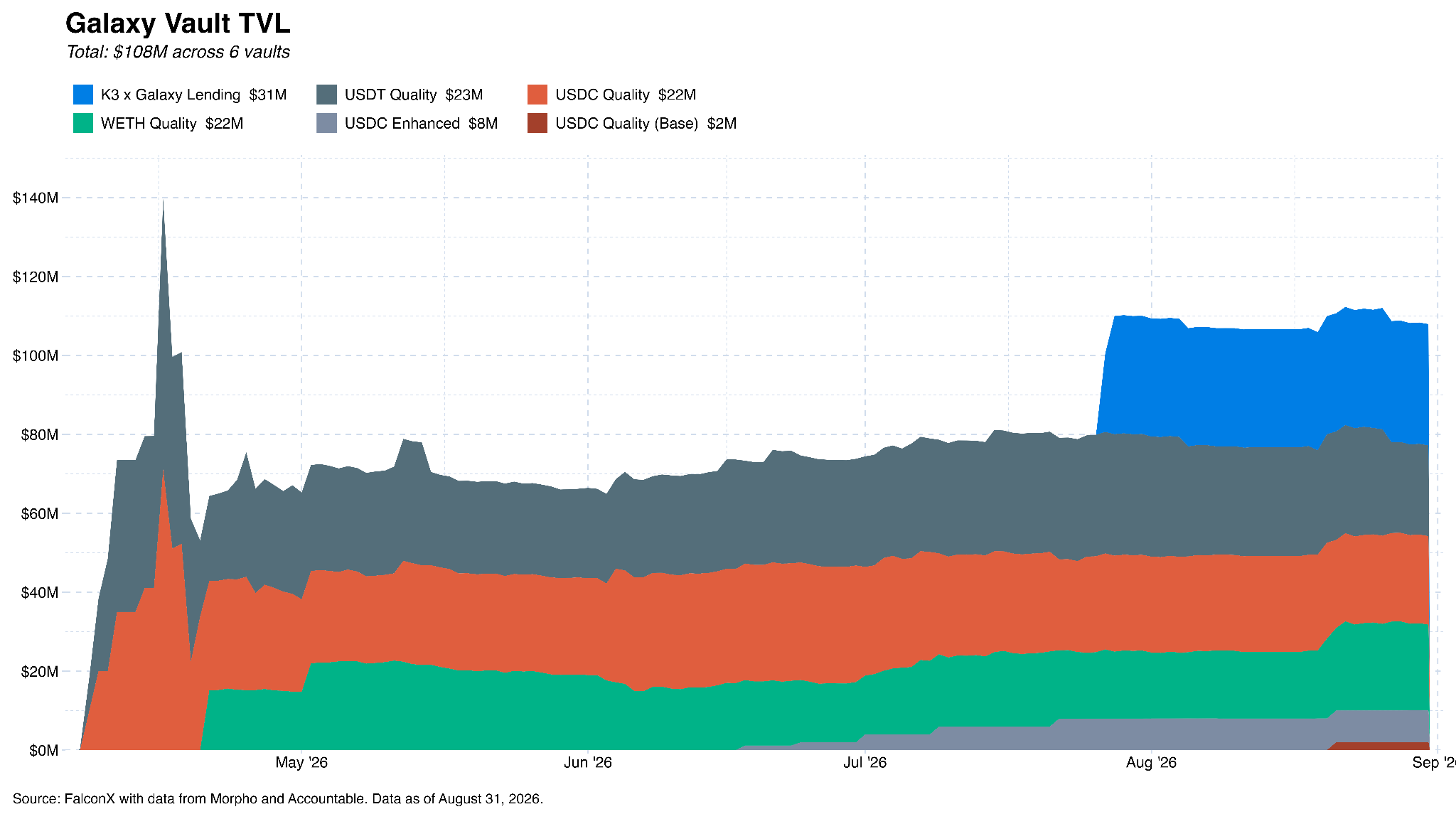
It curates 5 Morpho vaults with aggregate deposits of $77M per August 31, 2026. The vaults fall under two categories: those backed by blue-chip collateral, and those with higher-yield collateral types, including liquid restaking tokens, Pendle principal tokens, and Ethena products.
In addition to its curated vault offerings, Galaxy leverages Morpho to support its trading and lending businesses, such as sourcing stablecoin liquidity.
Separately, Galaxy is involved in a credit vault in partnership with K3 Capital, a $400M AUM manager running a large delta-neutral DeFi book. The vault sits on Monad and uses vault contracts from Accountable, which lists the vault on YieldApp, its yield marketplace. The vault is permissioned; users must be whitelisted to allocate AUSD into the vault.
K3’s role is essentially that of the curator, managing and extending AUSD loans exclusively to Galaxy. K3 uses waterfall maturity laddering, staggering assets across three 30-day tranches, opening a redemption window each month. A third of the loans mature every 30 days, enabling depositors to exit or to rollover into the next cycle. The vault had approximately $31M of deposits as of August 31, 2026.
The vault launched with incentives from Agora ($75k) and Monad, up to a total of $300K combined.
Wintermute
Algorithmic trading firm Wintermute launched its vault-curation business Armitage in May 2026 and now operates five Morpho vaults. Its ‘USDC Prime’ and ‘USDC Select’ vaults are described as designed end-to-end by Armitage, while its ‘Pendle Ecosystem USDC’ vault is in partnership with the Pendle team. In early September it also rolled out its ‘USDT Prime’ and ‘USDC Select’ vaults. As of September 2, 2026, it had $130M of deposits across its vaults.
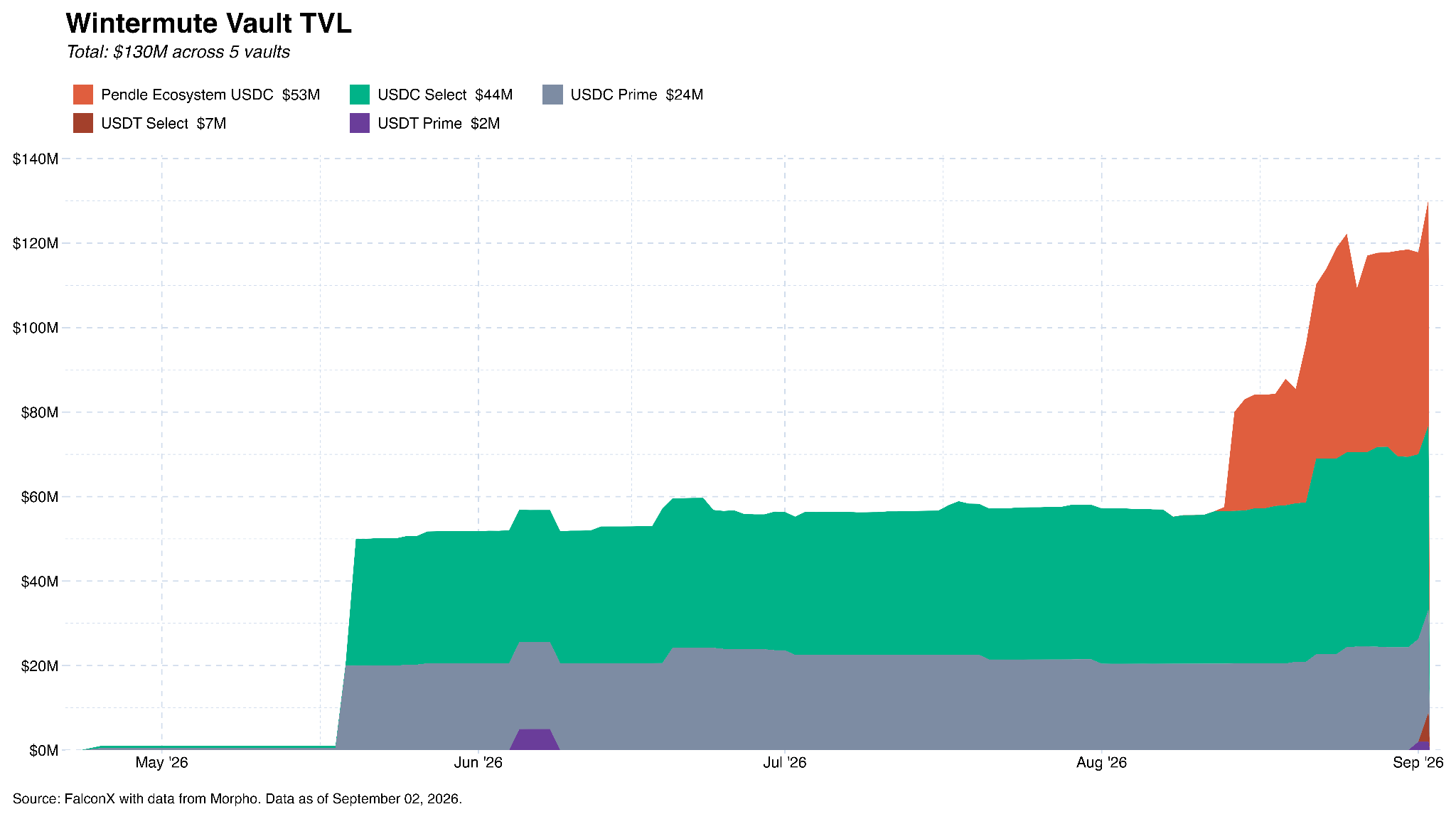
The Prime vault targets a more conservative risk profile, focusing exclusively on blue-chip crypto collateral markets, while the Select vault aims for a balanced risk/reward, mixing blue-chip collateral with higher-yielding opportunities. The Armitage site also highlights a planned ‘Apex’ tier of vaults targeting maximum yield. It outlines collateral could include exotic RWA markets, yield-bearing assets, and Pendle PTs.
The vaults are permissionless and non-custodial. Performance and management fees are currently 0% on the USDC Prime and Select vaults, while the Pendle USDC vault has a 5% performance fee.
Wintermute notes a key advantage of its vaults is that it can execute liquidations for all the markets it supports. This potentially allows it to support more collateral types relative to other curators. Moreover, this reduces reliance on other liquidators to appear in a liquidity crunch or when positions need to be unwound.
In addition, Wintermute’s borrowing activity on Wildcat, an undercollateralized lending protocol which it incubated and where it is the largest borrower, can help support its higher yielding vault strategies. This means Wintermute could funnel vault deposits into unsecured loans to itself through Wildcat, making the vaults with its Wildcat collateral partly a reflection of its own credit risk. We are already seeing this flywheel in practice, with its USDC Select Vault allocating approximately $6M to Wintermute’s Wildcat USDC market.
Consequently, through this vault strategy, Wintermute can provide borrowing capacity for its Wildcat creditors at up to 86% liquidation loan-to-value (LLTV). As of August 31, 2026, the Morpho v-wmtUSDC market pays 6.1% APY to USDC depositors, which compares to the 8.5% APR the Wildcat market pays.
Wintermute’s Prime and Select USDC vaults are supported in part by Merkl USDC rewards, while its Pendle USDC vault receives PENDLE token Merkl rewards. Its USDT vaults do not appear to have launched with Merkl rewards.
Keyrock
Market maker and trading firm Keyrock is involved as a curator, offering 3 vaults on Morpho: its USDC, USDT, and RLUSD vaults. Its Prime USDT and RLUSD vaults are described as deploying capital against blue-chip pairs, while its USDC vault allocates to markets using a mix of collateral, such as institutional credit, blue chip cryptos, and Pendle PTs. Keyrock’s vaults were initially launched in October 2025. The vaults have around $8M of deposits across them, nearly all in the USDC vault.
Flowdesk
Trading firm Flowdesk has its ‘AUSD RWA Strategy’ vault on Morpho ($7M TVL), where it allocates to markets backed by tokenized RWA. This currently takes the form of sUSDat, which is primarily exposed to STRC. This means it is effectively supplying USDC for STRC holders to borrow against.
Apart from its role as a curator, Flowdesk also taps into Morpho Markets to borrow or earn yield.
August Digital
On-chain prime broker August Digital has two USDC vaults on Morpho, on Monad and Ethereum, respectively. The Monad vault is supplemented with WMON Merkl incentives. Both vaults feature a management fee of 0.25%. August had $6M of deposits across its vaults, with the majority on its Monad vault.
Presto
Algorithmic trading and financial services firm Presto launched its Morpho vaults in July 2026. Its USDC Prime vault targets a conservative risk/reward profile, while its USDC Forte vault targets higher yield through private credit RWA collateral. Its Forte vault has a 15% performance fee. It has $3M of deposits across its vaults, with the majority on its Forte offering.
Bitwise
In January 2026, crypto asset manager Bitwise announced non-custodial vault curation powered by Morpho. Its initial vault strategy targeted 6% APY and was private.
On September 2, 2026, Bitwise announced its ‘Premium RWA Vault’, lending AUSD deposits against a set of overcollateralized real-world assets, including Hastra PRIME, Huma PST, and sUSDai. The vault has a management fee of 0.39% and had deposits of $8M as of September 3.
Takeaways
CeFi crypto players are becoming increasingly involved in the vault space, launching their own strategies or partnering with curators. ‘Earn’ programs from centralized exchanges are powering growth from the retail side, while trading desks and prime brokers are meeting institutional demand with credit vaults as well as a mix of yield strategies. Importantly, borrowing demand appears to have scaled with the growth in these vaults’ deposits, paving the way for further expansion, such as through potential bank and fintech involvement.
This material is for informational purposes only and is only intended for sophisticated or institutional investors. Neither FalconX Limited, FalconX Bravo, Inc., FalconX Delta, Inc., FalconX Golf Pte Ltd., Solios, Inc., Falcon Labs S. DE. R. L., KestrelX, Ltd., KingfisherX Limited, nor Banzai Pipeline Limited service retail counterparties, and the information in this material is NOT intended for retail investors. This material is not (i) an offer, or solicitation of an offer, to invest in, or to buy or sell, any interests or shares, or to participate in any investment or trading strategy, (ii) intended to provide accounting, legal, or tax advice, or investment recommendations, or (iii) an official statement of FalconX or any of its affiliates. Any information contained in this material is not and should not be regarded as investment advice, investment research, debt research, or derivatives research for the purposes of the rules of the CFTC or any other relevant regulatory body.
No discussion of a particular company or product shall be considered an endorsement of such company or product. Past performance is not indicative of future results. FalconX, and its affiliated parties, including 21shares, may hold positions in, act as a market maker for, or otherwise have a financial interest in, assets discussed herein, and may benefit from any price movements or transactions involving the subject company. This may change without notice.
Prior to entering into any proposed transaction, recipients should determine, in consultation with their own investment, legal, tax, regulatory and accounting advisors, the economic risks and merits, as well as the legal, tax, regulatory and accounting characteristics and consequences of the transaction. Pursuant to the Dodd-Frank Act, over the counter derivatives are only permitted to be traded by "eligible contract participants" (“ECP”s) as defined under Section 1a(18) of the CEA (7 U.S.C. § 1a(18)). Do not consider derivatives or structured products unless you are an ECP and fully understand and are willing to assume the risks.
Solios, Inc. and FalconX Delta, Inc. are registered as federal money services businesses with FinCEN. FalconX Bravo, Inc. is registered as a Swap Dealer with the U.S. Commodity Futures Trading Commission and is a member of the National Futures Association. FalconX Limited, FalconX Bravo, Inc., FalconX Delta, Inc., Falcon Labs S. DE. R. L., and Solios, Inc. are not registered with the Securities & Exchange Commission or the Financial Industry Regulatory Authority. FalconX Golf Pte. Ltd. is not registered or licensed by the Monetary Authority of Singapore (MAS). FalconX Limited is licensed by the MFSA as a Class 2 Crypto-Asset Service Provider (Regulation (EU) 2023/1114). It is also licensed as a Financial Institution (Cap. 376) exclusively for EMT payment services. FalconX is not a registered broker-dealer with the U.S. Securities and Exchange Commission (SEC) or a member of the Financial Industry Regulatory Authority (FINRA). FalconX’s ability to offer trading in tokenized stocks and other products mentioned herein may be restricted in certain jurisdictions.
"FalconX" is a marketing name for the FalconX Group and its affiliates. Availability of products and services is subject to jurisdictional limitations and capabilities of each FalconX entity. For information about which legal entities offer trading products and services, or if you are considering entering into a derivatives transaction, please reach out to your Sales or Trading representative.
.jpg)