Grass: Unlocking Live Data Access for the AI Agent Boom
Having found traction serving training data to AI businesses, Grass is now positioning to provide live data for inference requests.

Investing in digital assets or tokenized equities, and their respective derivatives, involves a substantial degree of risk. Market prices can be highly volatile and unpredictable. Movements in the market can result in significant, rapid, and potentially total loss of your invested capital. Before allocating capital, you should carefully evaluate whether such investments align with your financial situation, experience, and risk tolerance. For further information regarding potential risks, please refer to the disclaimer below.
Grass, a decentralized physical infrastructure protocol serving data across the AI industry, has emerged as one of the few protocols in its vertical with growing enterprise revenue (~6x YoY growth in 1H26 to $17M) and a cost structure that has inflected into profitability. Despite this, GRASS trades at ~10x FDV to its FY26 revenue guidance (~$70M), below private AI data peers and revenue-generating crypto protocols.
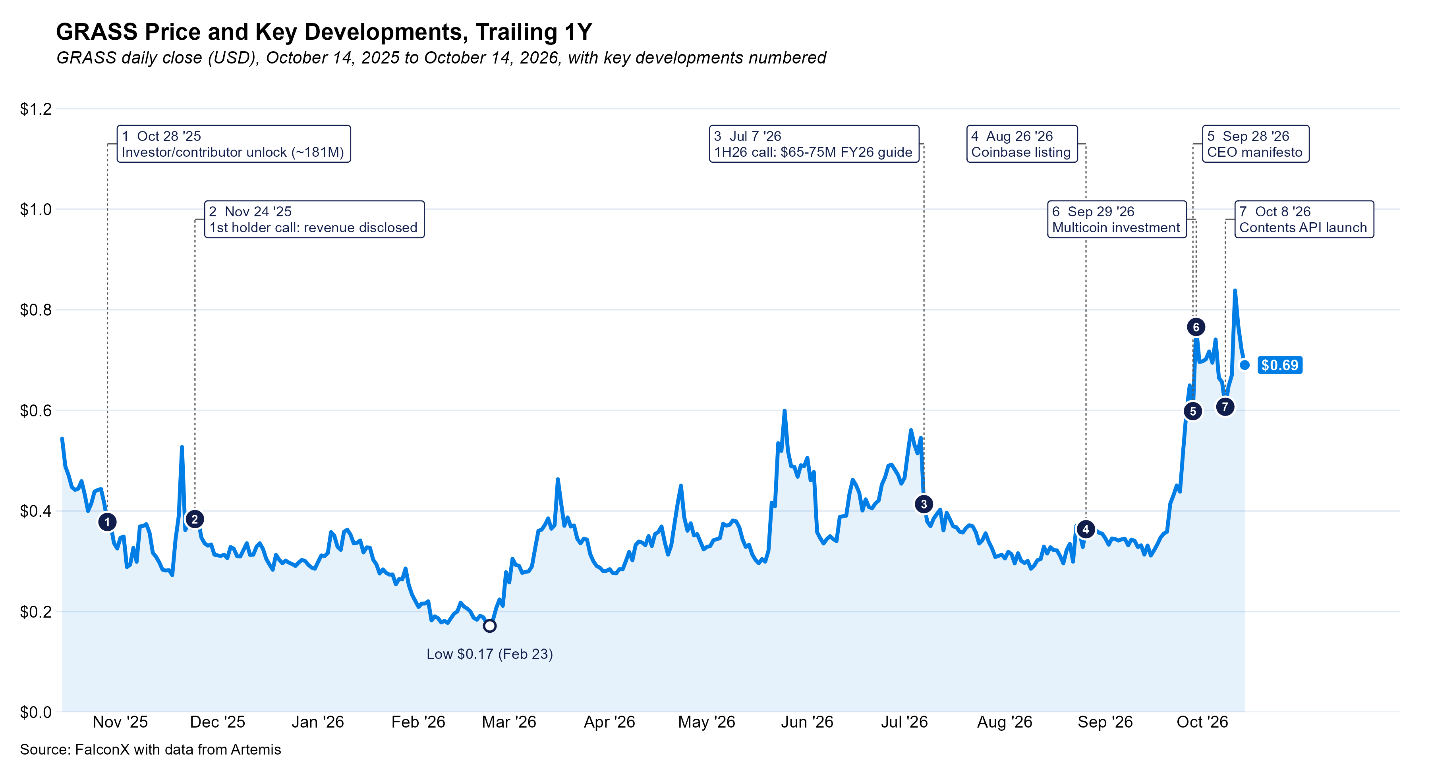
Recent AI trends of falling token costs and rising usage may support the project, as this combination is expected to drive increased agentic activity. This in turn drives demand for real-time or fresh data, aligning with Grass’s recently launched Live Context Retrieval (LCR) offering.
Overview of Grass
Grass is a Solana-based DePIN that provides access to public web data, in the form of curated training datasets sold to frontier AI labs, and self-serve APIs for real-time data. Users opt in to share their unused bandwidth as nodes on the network, contributing the reach of residential IPs to the network to pull public data from the web in return for payments. The network counts approximately 8.5M monthly active nodes across 190+ countries. Residential IPs give the protocol an edge against data center IPs, which are often banned from accessing certain websites (seen as malicious traffic and not “real” users). This means valuable data for training models and running real-time AI applications may increasingly face bot restrictions, making it harder for AI labs and businesses to source.
The protocol saw the market for training data as the immediate opportunity, and has built revenue streams from AI labs looking to source as much data as possible to train new frontier models. The constraint here revolves around the amount of data available, and older data for training is already considered near-exhausted. Fresher data supplements the gap and helps keep models up to date given they train continuously on new information. Grass has noted strong demand for training data, especially data that is hard to access from datacenter proxy networks, and this area is currently behind most of its revenue.
Revenue Profile and Cost Structure
One prior point of concern amongst investors evaluating GRASS was the opaqueness around customers and the business. Grass maintains it is bound by confidentiality agreements and cannot disclose individual clients by name. However, to help deliver some transparency, it published an independent attestation of its revenue through 2Q26, conducted by Regen Financial.
In July 2026, Grass stated it has worked with frontier labs and said its customer base includes leading private AI companies, members of the Mag7, and several of the most closely watched new labs. The latter cohort could be some of the labs focused on open-source models, which, if that is the case, could demonstrate Grass’s data offerings are relevant to both closed-source and open-source AI. Notably, Grass stated it has “seen repeat business from nearly every AI customer”, suggesting revenue durability. Its revenue model is also expanding from one-off datasets to include recurring subscription crawls, with rising demand for multimodal data versus text.
On its 1H26 token holder call held on July 7, Grass stated its 1H26 revenue of $17M grew ~6x YoY, yet only increased around 19% from 2H25. Per Grass, this is because training data demand is seasonal and Grass expects more to shift into the back half of the year, anticipating ~$52M of revenue in 2H26 (+266% YoY), guiding to total FY26 revenue of $65-$75M from training data alone. The 2H26 target is roughly 3x 1H26, making its next revenue update a key checkpoint.
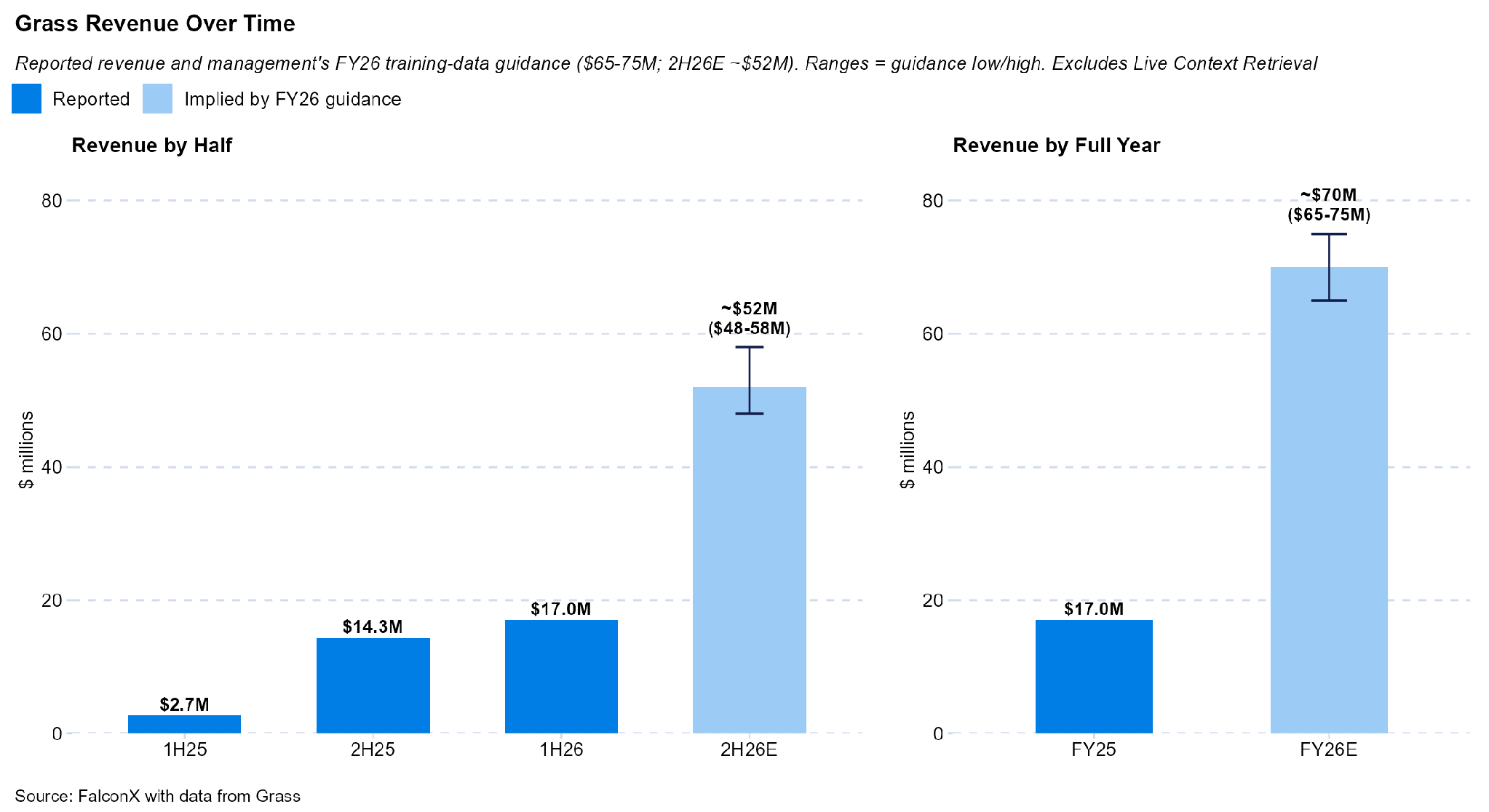
On the cost side, Grass disclosed its ongoing expenses total $2M-$3M/month, largely infrastructure related. Headcount for the 45 FTE team supporting Grass accounted for 20% of its 1H26 costs. At the guidance midpoint, this implies an operating margin of roughly 50%-65%, consistent with Grass stating it reached profitability near the end of 2025.
For context on its node operator payments, it distributed $3M USDC in node operator rewards between October 2024 and June 2026 across nearly 6.3M users, which would suggest ~$150K/mo. However, rewards were highly concentrated, as 150k users accounted for roughly 90% of network traffic, due to the network prioritizing bandwidth usage and geographies.
Taking the Process In-House
As the scale of its crawling activities grew, Grass moved to own key components of the retrieval and processing chain to capture efficiencies. Specifically, it built its own data center environment for custom storage and compute infrastructure to support network efficiency. As of July 2025, it stated its high-speed storage operated at 10% of the cost and at 2x the throughput of traditional cloud object storage, while its tape-based cold storage was 4% the cost of archival cloud storage. Moreover, its compute servers were up to 95% cheaper than cloud reserved instances when including bandwidth.
These changes have enabled Grass to scrape as much as 4PB/day of data. As of July 2026, it said its infrastructure investments have reduced the network’s operating expenses by $1M+/month.
Fundamentals Intact, Now Tokenomics in Focus
With the business seeing traction based on its realized and projected revenue, the project has taken steps to address concerns around value accrual.
It clarified that it has no equity financing (and has no plans to introduce an equity component), with all money raised going through its token. The token sits as the primary economic instrument of its ecosystem instead of competing with equity for value accrual. Contract revenue accrues to Grass DataCo, a subsidiary of the memberless Grass Foundation, while Wynd Labs, the core development team, is engaged as a vendor.
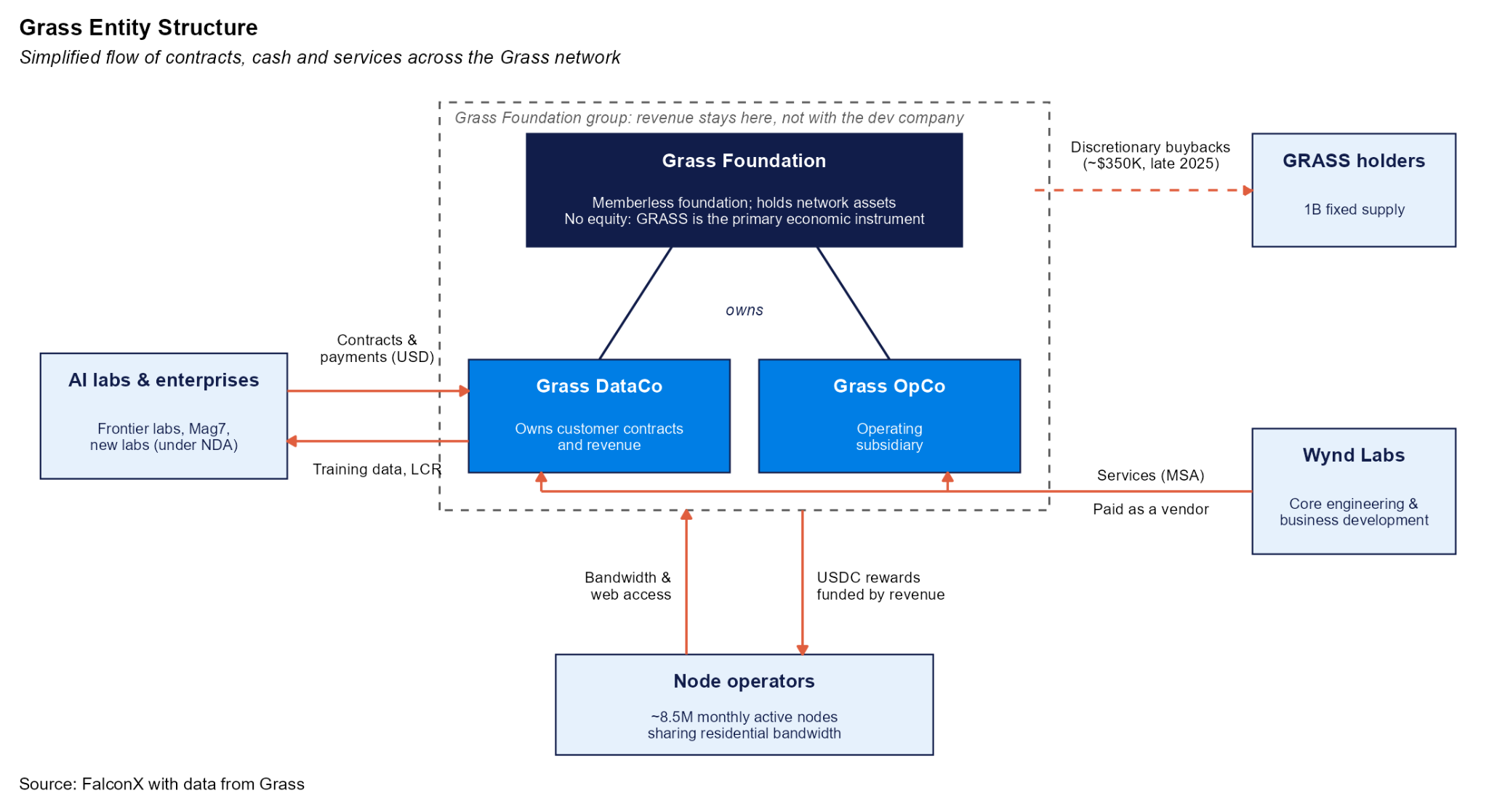
The transition towards node operator payouts in USDC instead of the GRASS token eliminates net new emissions. Node operators can be funded sustainably from system revenue.
However, there remains no formalized direct value accrual for the GRASS token, given the project’s stated guidance of reinvesting the majority of revenue into network growth. It’s worth noting Grass revealed $350K of discretionary buybacks in late 2025. Codifying buybacks in some form once the network is mature enough could be a potential catalyst for the token.
On the supply side, the token’s October 28 unlock (~20M GRASS, or ~2.8% of circulating supply) includes the final monthly release for early investors, according to data from DefiLlama. This eliminates around 10.5M GRASS of scheduled unlocks from this investor cohort each month going forward.
Live Context Retrieval (LCR)
The newer, and potentially more lucrative, market for the project is LCR, where live web data is scraped and provided for AI model inference. This means that models have access to real-time data, supplementing the ‘stale’ knowledge they were trained on. It is positioning this part of its business to meet the ‘exponential’ demand for inference. Moreover, given its crawling and now inference data capabilities, Grass is also developing a Search API, allowing AI tools to more efficiently find the data they are searching for, adding another potential revenue stream.
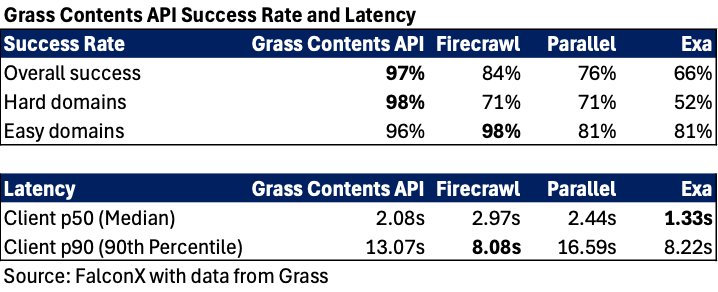
On October 8, 2026, Grass announced the launch of its Contents API. At the start of the month, Grass said it tested its solution against peers Firecrawl, Parallel, and Exa across 100 public web destinations. Grass outperformed this cohort when retrieving hard-to-access domains, while scoring competitively on easy-to-access domains. Latency in delivering content was also competitive, with Grass exhibiting a median client latency of 2.08 seconds on a common-access set of sites, faster than Firecrawl and Parallel, but behind Exa. One caveat is that Grass noted that latency tends to be higher for sites that are difficult to access; however, this may not be a concern when its peers may not be able to access those sites at all. While its own benchmarking shows potential, it may trail peers on developer distribution and agent integrations.
Recent and Upcoming Catalysts
Multicoin Capital announced an investment in Grass in late September by both its hedge fund and venture fund, which drew headlines. Its thesis is grounded in the LCR offering propelling growth, considering inference-time data retrieval a market “likely several orders of magnitude larger than pretraining data”, thanks to recurring data requests from agents.
Other potential near-term catalysts include the launch of the Search API that is in the works, and any potential future disclosures around Contents API traction or 2H26 revenue, which have not yet been announced at the time of writing. In mid-October, Wynd Labs CEO Andrej Radonjic shared that Grass LCR was already serving 4M+ external requests per day shortly after its launch.
Valuation Thoughts
Assuming its moat of residential IPs and owned infrastructure remains viable in the future, GRASS appears positioned to capture much of the growth in AI adoption. Growing token consumption may be a reasonable function of AI demand, with weekly token usage of models across OpenRouter up ~31x YTD through October 5, 2026. While this partly reflects growth of open-source models vs frontier ones, all of these kinds of models will need data for training or inference. Therefore, we think it is not unreasonable that GRASS could see demand growth at a fraction of that pace (i.e., the ~4x growth it is forecasting this year).
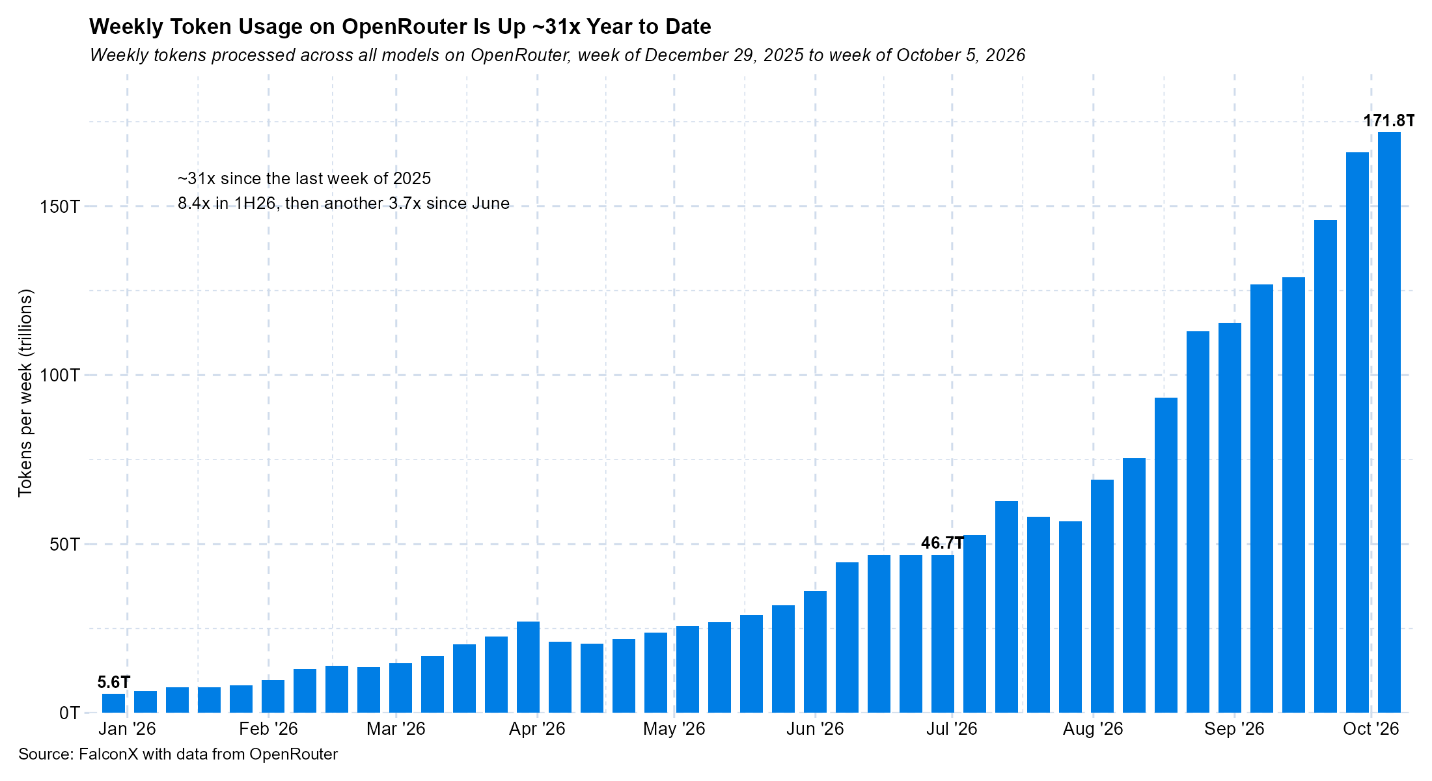
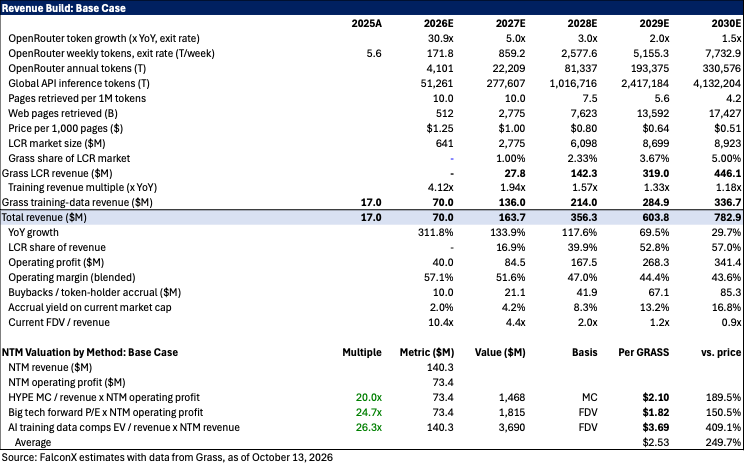
However, token growth in this context overstates spend growth, as cheaper open-weight models drove most of it. Closed-source labs’ share of OpenRouter tokens fell from ~35% to ~7% YTD. We therefore model training revenue growth at a dampened rate relative to token growth (calibrated to this year’s ~4x revenue vs. ~31x token growth), while LCR grows at a faster rate. Our base case projects approximately $165M of total revenue in 2027 and $355M in 2028, with LCR growing up to 40% of revenue in 2028, reflecting the trend of increasing agentic inference demand.
Key assumptions include OpenRouter as approximately 8% of global API inference tokens (it processed around 8% as many tokens as the Google and OpenAI APIs combined in April), and that roughly 10% of tokens come from web-grounded work, in line with OpenRouter’s task data on search, research, Q&A, and data extraction. That work fetches ~100 pages per 1M tokens, priced at ~$1 per 1,000 pages (current Exa and Parallel list prices and the low end of Grass’s own $0.75–$1.11 per 1,000 credits, with JavaScript and anti-bot pages costing 2–3 credits). We further assume retrieval intensity and pricing each decline 20%-25% a year. We project Grass could capture 1% of this market in 2027, rising to 5% by 2030, at a 35% operating margin given node payouts and infrastructure costs, versus 55% for training data.
Base Case Revenue Model
Peer Comparables
As of October 13, GRASS trades at approximately 13x MC and 18x FDV to estimated operating profit per its FY26 guidance, below crypto bellwethers such as HYPE at ~20x. On the private side, AI data providers Scale AI, Surge AI, and Mercor were previously valued at up to ~25x-29x revenue, while big tech trades at ~17x-35x forward earnings, per our analysis.
In October, Exa announced it passed $100M in annualized revenue, which, at its $2.2B May valuation, would suggest a ~22x revenue multiple vs. GRASS at ~10x its FY26 guidance (~7x its implied 2H26 run-rate). This suggests GRASS has faced a structural discount, which it could close if it continues to execute on its data moats.
Applying these multiples to our base case next-12-month estimates, the average of the resulting valuations implies a potential GRASS price of ~$2.53, over 3x today’s levels. However, it is possible that even with strong growth in its training and LCR activities, crypto participants may remain reluctant to close the gap in valuations until a formal value accrual policy is established.
Relative Valuations: GRASS vs. Private Comparables

Potential Headwinds
Potential challenges for Grass could include legal and regulatory risks. Automated scraping legality may be contested in different jurisdictions and regulators could look to challenge it. Moreover, aspects of the Grass network could violate website or ISP terms of service around commercial scraping. This could limit Grass’ ability to utilize IPs in certain geographies.
Limited client disclosure also leaves some opacity around the business, partially offset by the revenue attestation Grass released earlier this year. It is possible revenue could be concentrated amongst just a handful of customers, raising risk, compounded by the seasonality of the training data business.
Some AI trends may also reduce demand for scraped data. Labs may look to internalize data collection to cut costs or move to using synthetic data to replace some of their data needs. Separately, inference requests may become more efficient over time, leading to fewer searches/data requests, which could impact Grass’ LCR offering.
Grass also faces potentially increased competition. Other crypto peers such as BAT have launched similar offerings for AI use cases, such as a Search API, that may overlap with Grass’ own offerings. Moreover, Grass’ LCR still underperforms on certain benchmarks vs peers, suggesting more work needs to be done to better compete in this area.
Finally, limited token utility at the moment may make the protocol less attractive to certain investor cohorts. Grass plans to reinvest in its business, putting actions such as buybacks likely on the backburner for the time being. Until a value accrual policy is enshrined, investors may price it at a discount to peers.
Summary
Grass has positioned itself as a unique data supplier for AI labs thanks to its vast network of residential IPs. It is now poised to support inference data requests as well, supported in part by its infrastructure investments. With a cleaner value accrual structure than other DePIN projects (no equity competing with the token), GRASS remains a project to watch as AI adoption accelerates.
This material is for informational purposes only and is only intended for sophisticated or institutional investors. Neither FalconX Limited, FalconX Bravo, Inc., FalconX Delta, Inc., FalconX Golf Pte Ltd., Solios, Inc., Falcon Labs S. DE. R. L., KestrelX, Ltd., KingfisherX Limited, nor Banzai Pipeline Limited service retail counterparties, and the information in this material is NOT intended for retail investors. This material is not (i) an offer, or solicitation of an offer, to invest in, or to buy or sell, any interests or shares, or to participate in any investment or trading strategy, (ii) intended to provide accounting, legal, or tax advice, or investment recommendations, or (iii) an official statement of FalconX or any of its affiliates. Any information contained in this material is not and should not be regarded as investment advice, investment research, debt research, or derivatives research for the purposes of the rules of the CFTC, the Securities and Exchange Commission, or any other relevant regulatory body.
No discussion of a particular company or product shall be considered an endorsement of such company or product. Past performance is not indicative of future results. FalconX, and its affiliated parties, including 21shares, may hold positions in, act as a market maker for, or otherwise have a financial interest in, assets discussed herein, and may benefit from any price movements or transactions involving the subject company. This may change without notice.
Prior to entering into any proposed transaction, recipients should determine, in consultation with their own investment, legal, tax, regulatory and accounting advisors, the economic risks and merits, as well as the legal, tax, regulatory and accounting characteristics and consequences of the transaction. Pursuant to the Dodd-Frank Act, over the counter derivatives are only permitted to be traded by "eligible contract participants" (“ECP”s) as defined under Section 1a(18) of the CEA (7 U.S.C. § 1a(18)). Do not consider derivatives or structured products unless you are an ECP and fully understand and are willing to assume the risks.
Solios, Inc. and FalconX Delta, Inc. are registered as federal money services businesses with FinCEN. FalconX Bravo, Inc. is registered as a Swap Dealer with the U.S. Commodity Futures Trading Commission and is a member of the National Futures Association. FalconX Limited, FalconX Bravo, Inc., FalconX Delta, Inc., Falcon Labs S. DE. R. L., and Solios, Inc. are not registered with the Securities & Exchange Commission or the Financial Industry Regulatory Authority. FalconX Golf Pte. Ltd. is not registered or licensed by the Monetary Authority of Singapore (MAS). FalconX Limited is licensed by the MFSA as a Class 2 Crypto-Asset Service Provider (Regulation (EU) 2023/1114). It is also licensed as a Financial Institution (Cap. 376) exclusively for EMT payment services. FalconX is not a registered broker-dealer with the U.S. SEC or a member of the Financial Industry Regulatory Authority (FINRA). FalconX’s ability to offer trading in tokenized stocks and other products mentioned herein may be restricted in certain jurisdictions.
"FalconX" is a marketing name for the FalconX Group and its affiliates. Availability of products and services is subject to jurisdictional limitations and capabilities of each FalconX entity. For information about which legal entities offer trading products and services, or if you are considering entering into a derivatives transaction, please reach out to your Sales or Trading representative.