Convergence is Here – And it Extends Beyond Hyperliquid
Traditional assets are increasingly driving activity across crypto venues.

Investing in digital assets or tokenized equities, and their respective derivatives, involves a substantial degree of risk. Market prices can be highly volatile and unpredictable. Movements in the market can result in significant, rapid, and potentially total loss of your invested capital. Before allocating capital, you should carefully evaluate whether such investments align with your financial situation, experience, and risk tolerance. For further information regarding potential risks, please refer to the disclaimer below.
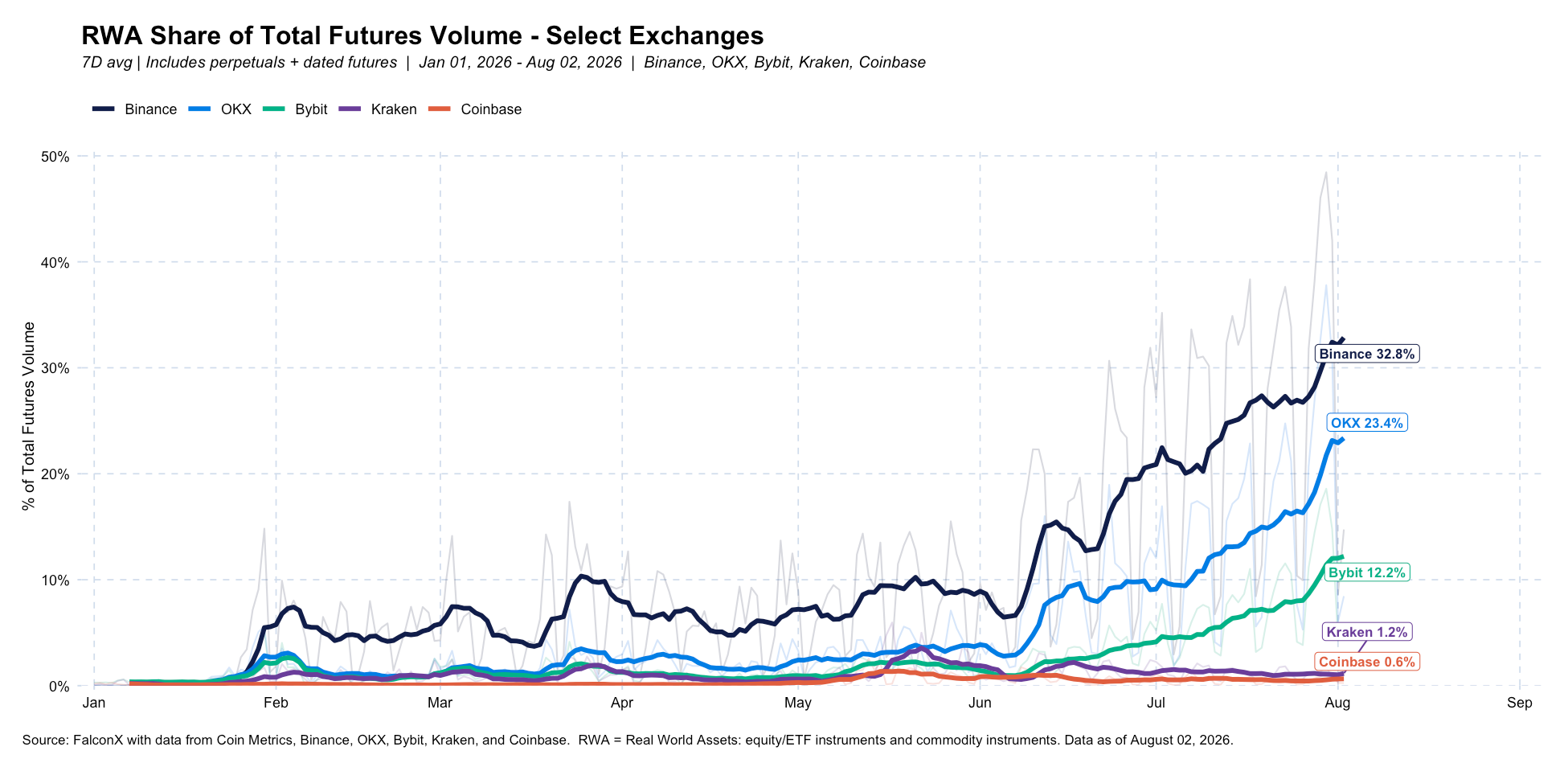
It’s no secret that real-world assets (RWA) are gaining volume share across major crypto venues, but the scale may be underappreciated. For example, Binance’s TradFi perpetual volumes grew nearly 14X in 7 months to over $400B of volume in July, with nearly a third of all Binance future volumes now non-crypto. While Hyperliquid was initially the poster child for the ‘convergence’ trend of traditional markets being traded on crypto venues, similar dynamics are now playing out across crypto exchanges more broadly.
Drivers behind the expansion of the RWA trends include new product launches, such as tokenized stock offerings, pre-IPO markets, and perpetual future markets on traditional assets. Promotions, such as trading fee reductions, may also be contributing to activity. Another factor is trading volume mix, where crypto volumes have softened over the past year (2Q26 spot and futures volumes declined 42% and 31% YoY, respectively), while RWA-related markets are seeing growth. Furthermore, and as reports suggest, the massive rotations in traditional asset classes this year may have siphoned interest from crypto markets into the seasonal summer crypto trading lull, resulting in record RWA volume share.
Hyperliquid RWA Volumes Exceeded 50% of Total Perp Volumes in July
Hyperliquid was an early mover in bringing traditional markets on-chain when it rolled out HIP-3 markets in October 2025, allowing permissionless deployments of perpetual futures markets. HIP-3 volumes have climbed to new records YTD and comprised a record high of 73% of total Hyperliquid perpetual futures volumes on July 30, per data from Artemis. July was the first month in history that HIP-3 volumes comprised more than half of platform perp volumes (51%).
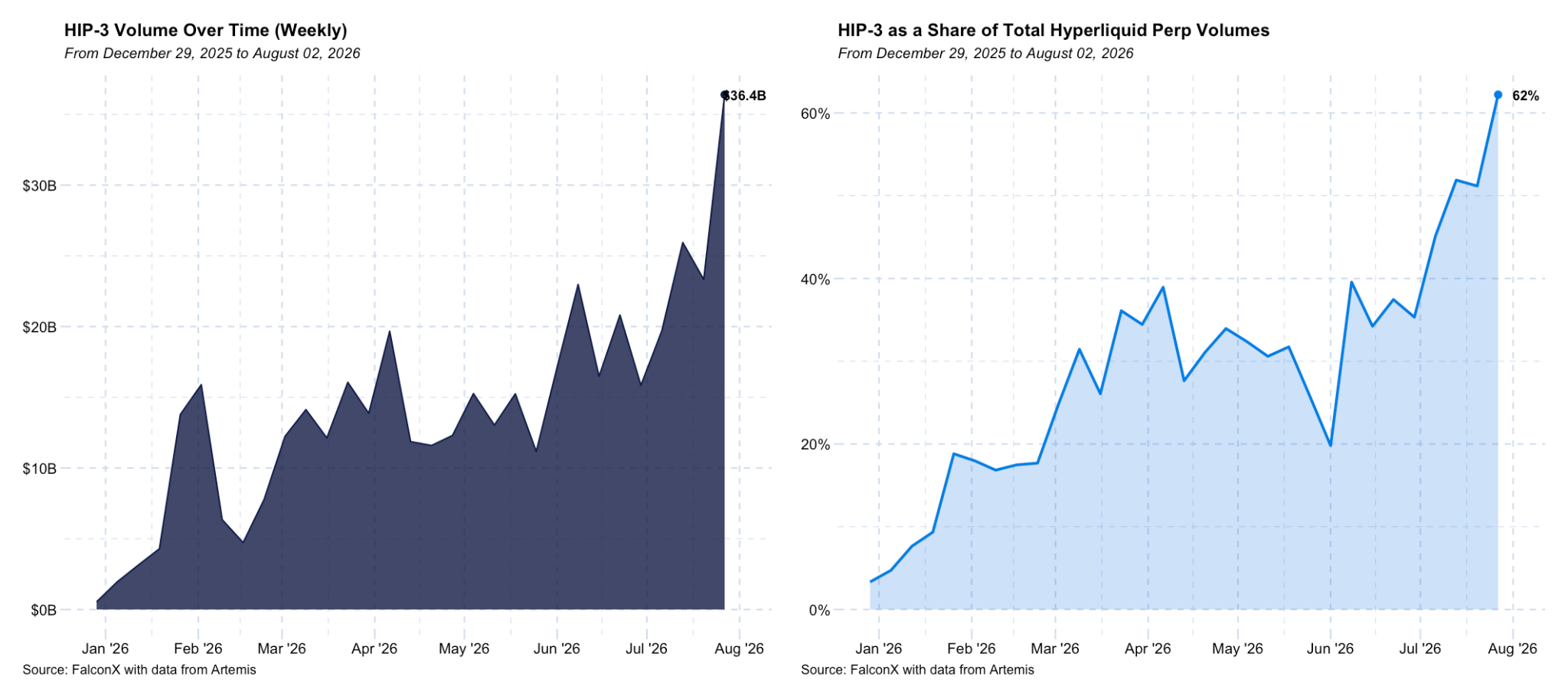
The greater HIP-3 share can also be partially explained by mix. HIP-3 volumes are growing, crypto volumes on Hyperliquid are contracting. Non-HIP-3 perp volumes declined 40% MoM in July, while HIP-3 volumes increased 36%, per data from Artemis.
HIP-3 markets posted all-time high volumes on July 29 of $9.0B, according to data from Artemis. Trading in perps on Korean AI-related stocks, such as SK Hynix, supported the latest surge in volumes.
Centralized Exchanges Also See Convergence
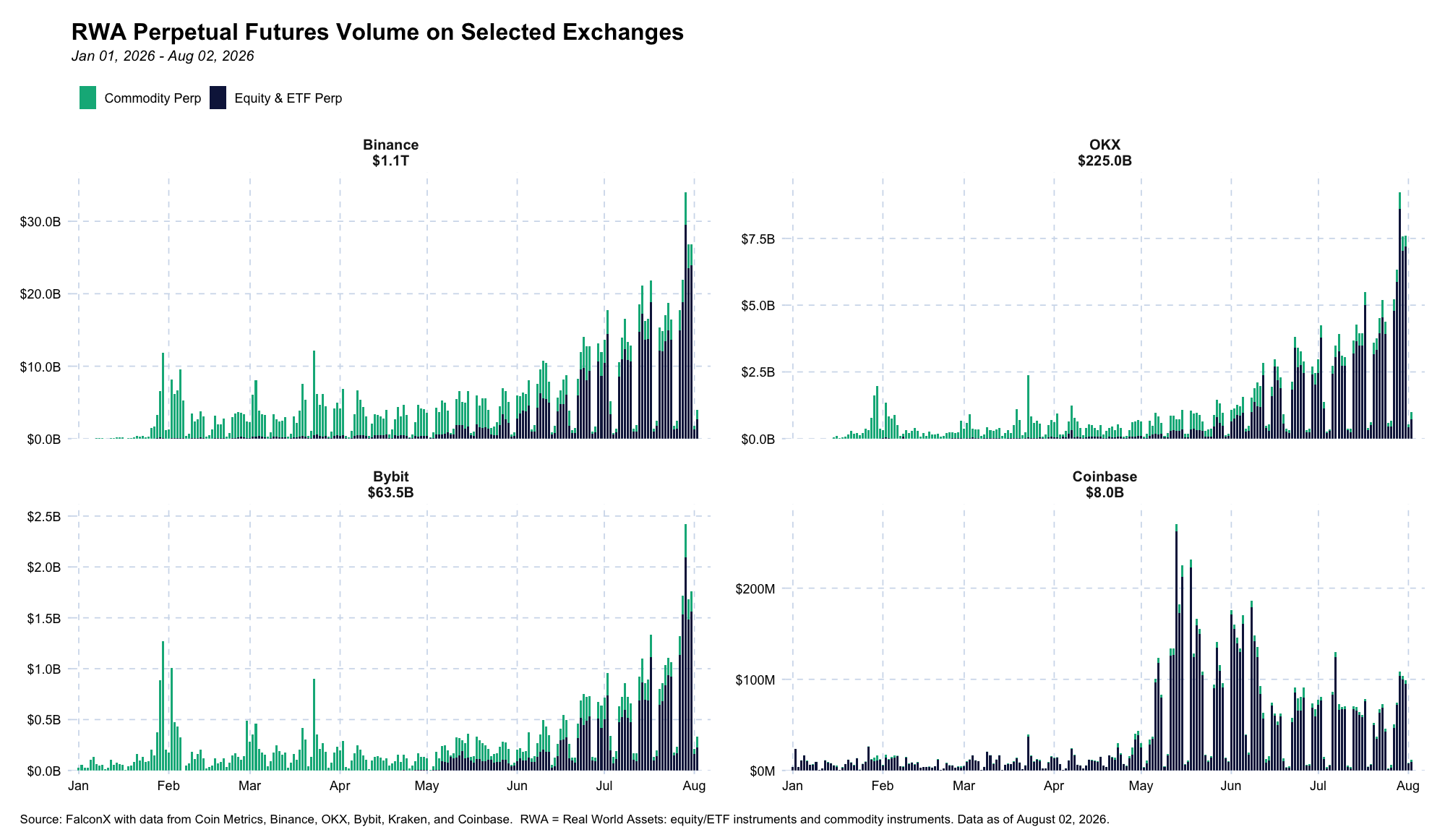
The same ‘convergence’ dynamics playing out on Hyperliquid are also manifesting on centralized exchanges, where RWA perpetual futures are gaining share, with the trend accelerating since June. Binance has quietly seen over $1T of volume on its TradFi perps YTD alone, which is nearly 2.5X HIP-3 volumes over the period ($431B, per Artemis). So while this RWA trend may be more telegraphed around Hyperliquid, it is occurring on a similar or larger scale on centralized venues.
The interest and volatility in AI stocks is a likely driver of the growth in RWA instruments here, with the SPCX IPO driving volume and attention to these markets, such as via the SPCX pre-IPO perps that crypto exchanges launched.
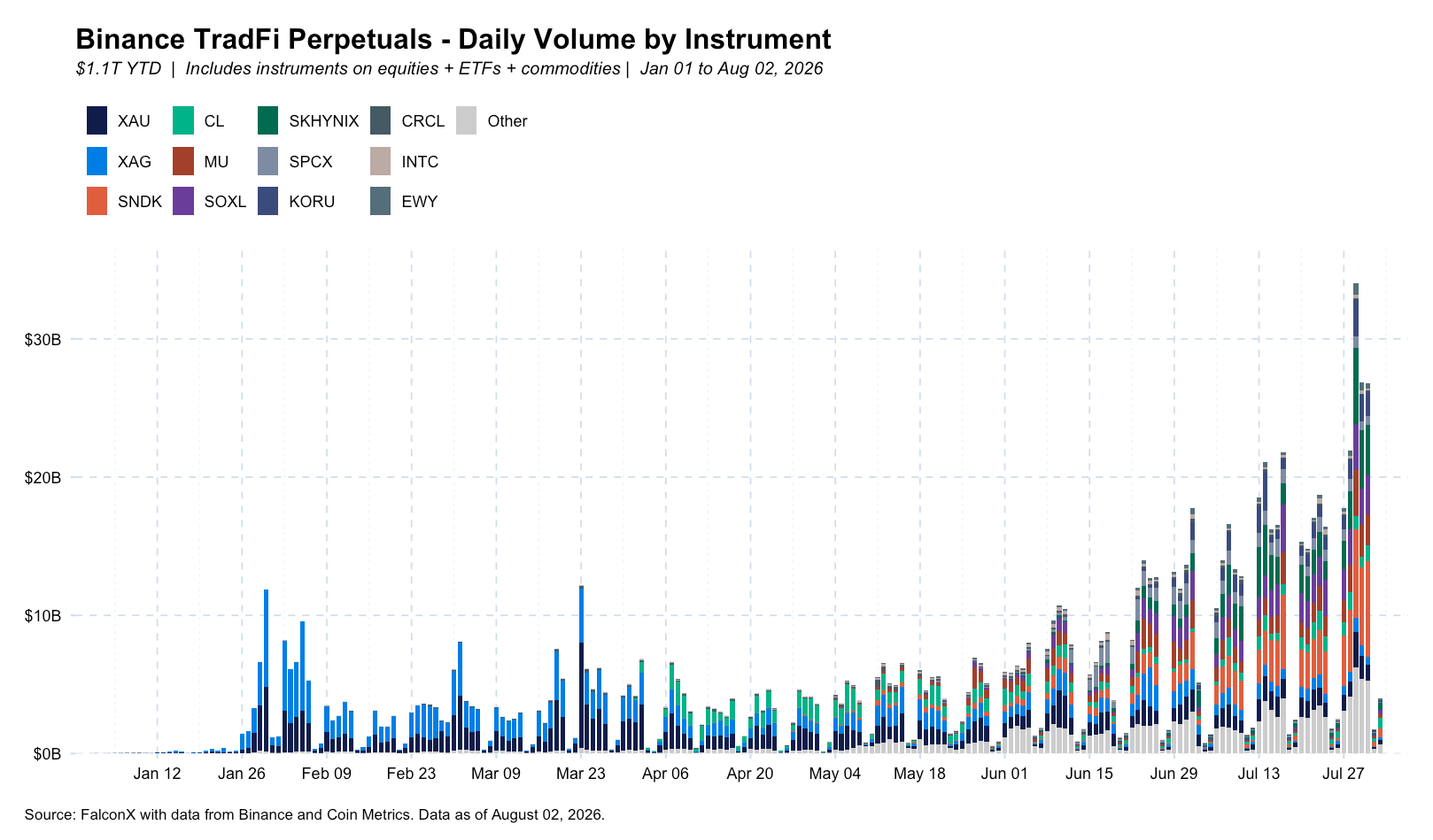
On the futures side (includes dated futures and perpetuals), the trend has been most pronounced on Binance, where the 7D RWA share of its total futures volume stood at approximately 33% as of August 2, and individual days saw this share tap as much as 49% in late July. Binance has seen rising activity in this area all year, after it launched TradFi Perpetual Contracts in January 2026.
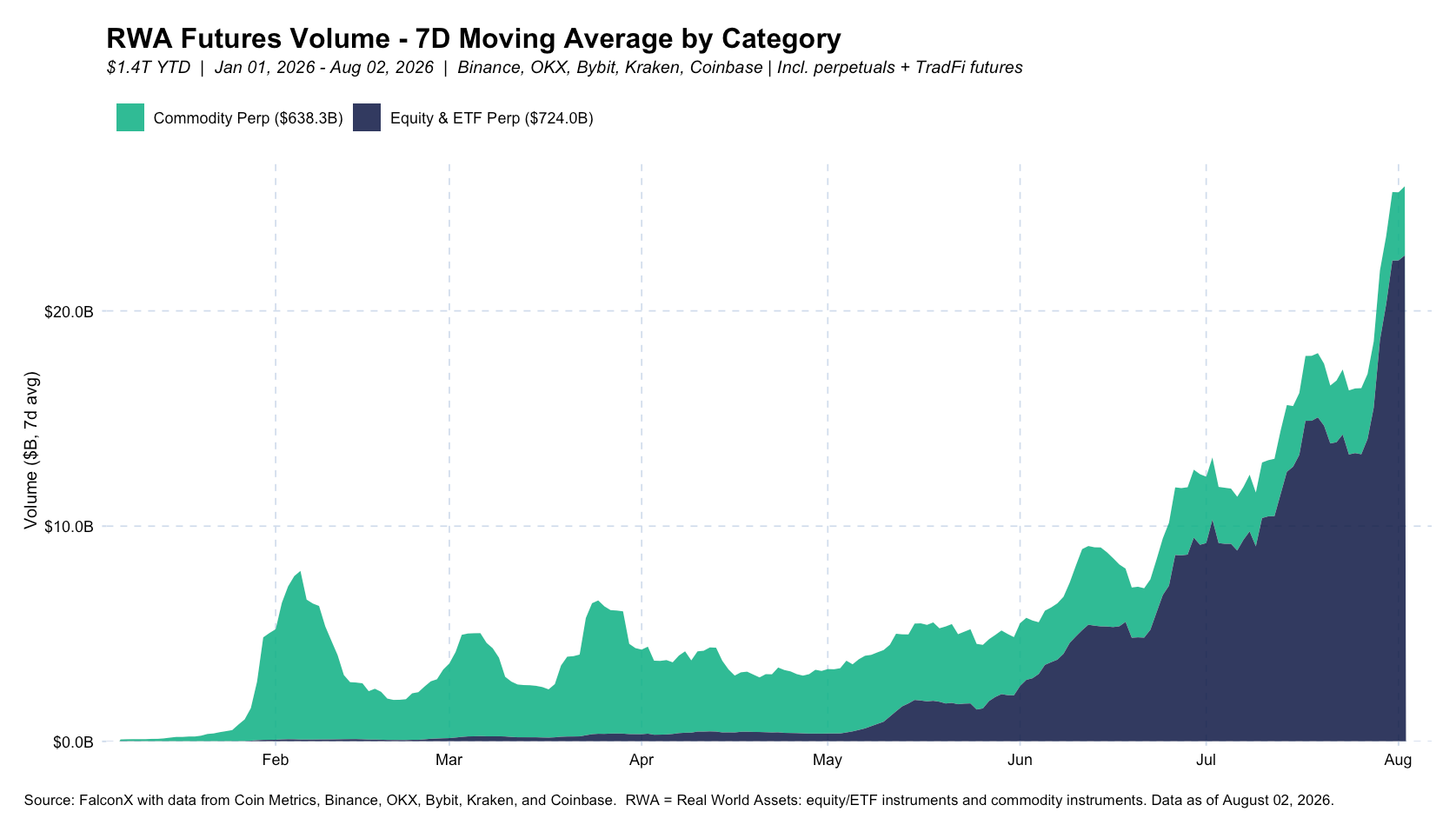
Volumes on the RWA perp front exhibit the shift in markets. These were initially concentrated in commodity perps (such as gold and oil) and are now largely comprised of equity perps.
Centralized Exchange Spot RWA Activity
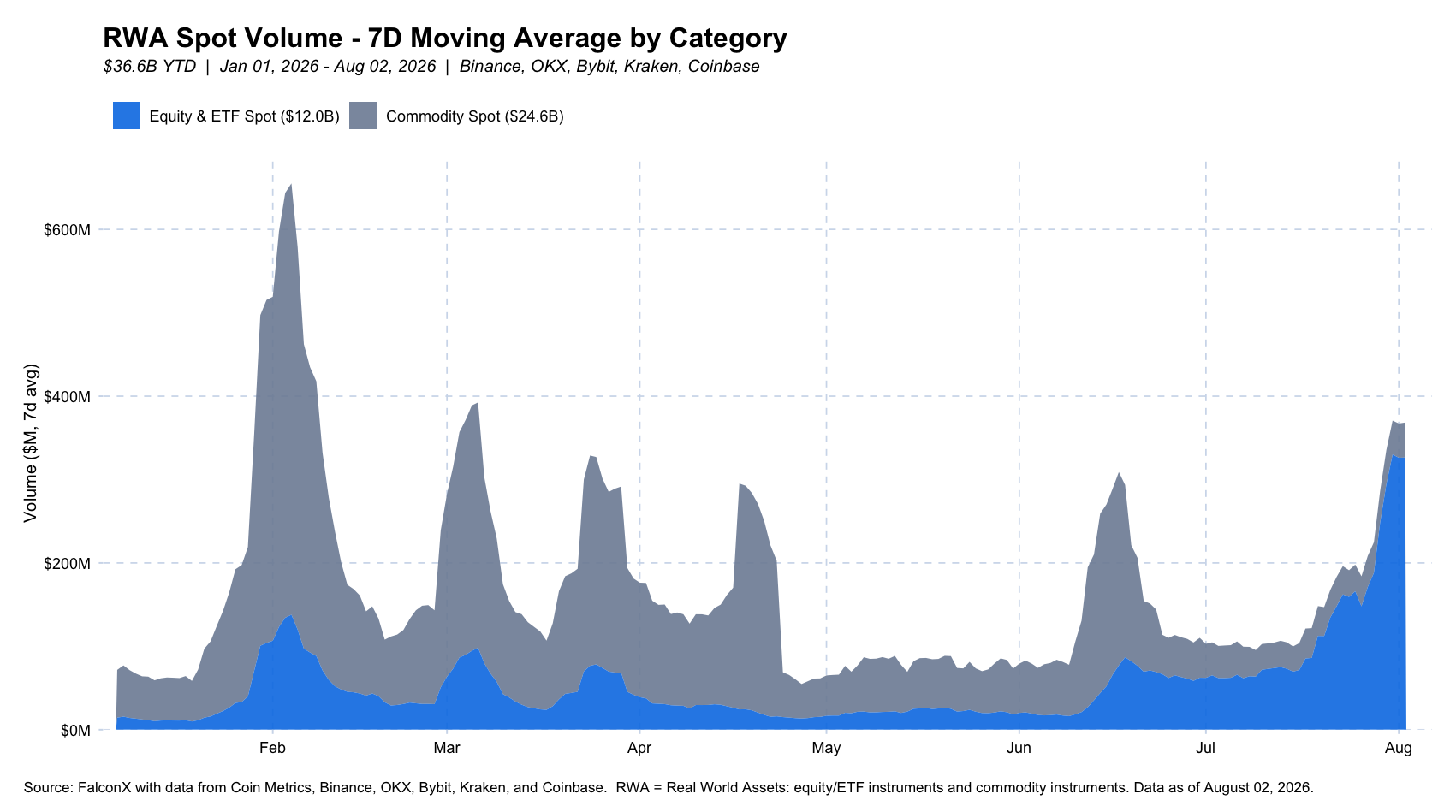
Activity earlier in the year in the spot category was largely in commodity-backed tokens, such as PAXG and XAUT. Tokenized stock offerings for some of these exchanges didn’t come until later in the year.
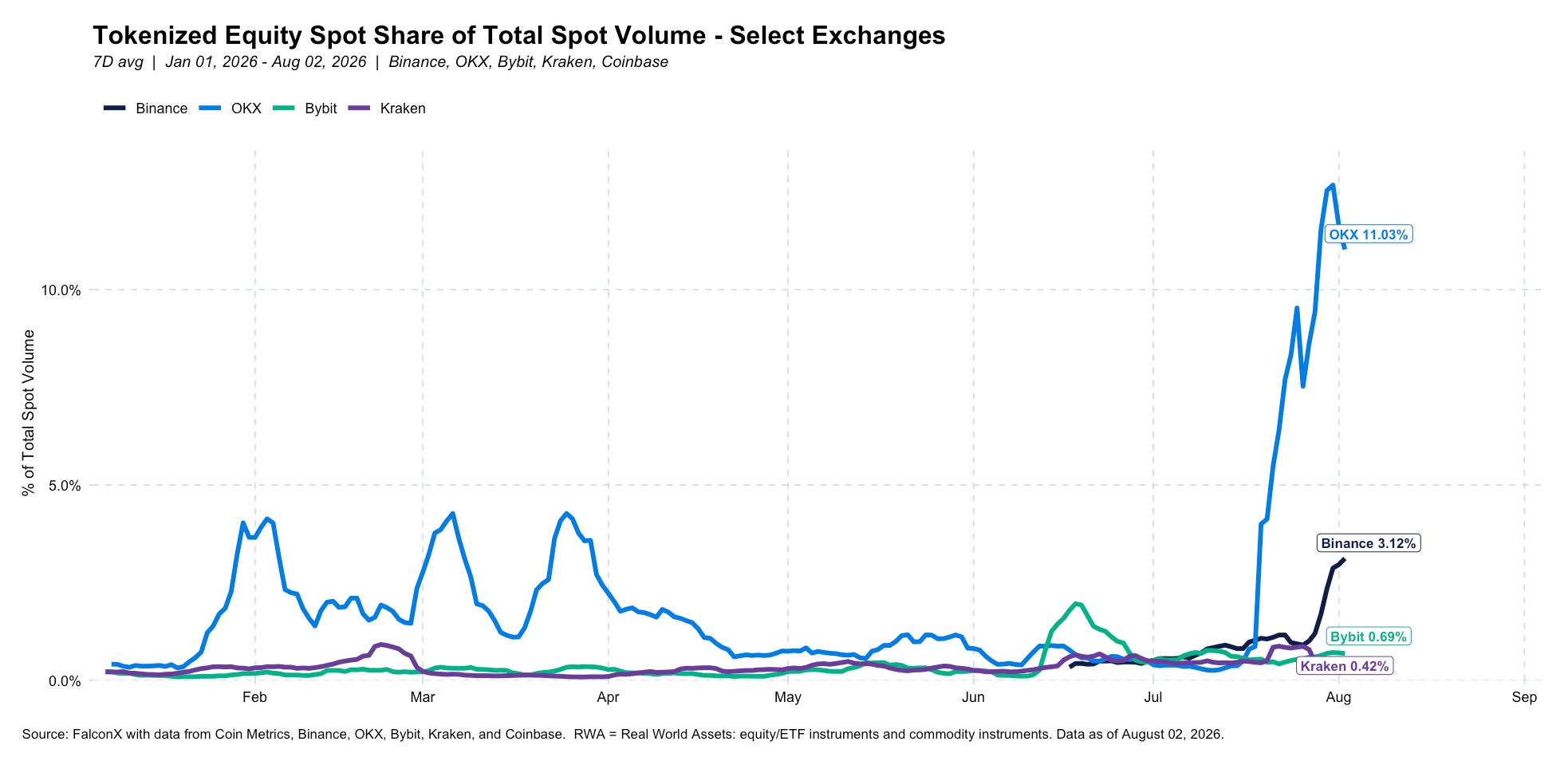
RWA activity in spot markets is seeing rising activity lately after Binance launched its bStocks tokenized stocks offering in mid-June, which are 1:1 backed by shares held at a regulated custodian.
OKX also launched tokenized stocks and ETFs in mid-July 2026. Unlike other tokenized stock products, its offering aims to standardize how different issuers map to a single market for each stock to reduce liquidity fragmentation. It currently uses xStocks, but hints at supporting additional issuers in the future.
Tokenized Stocks in DeFi
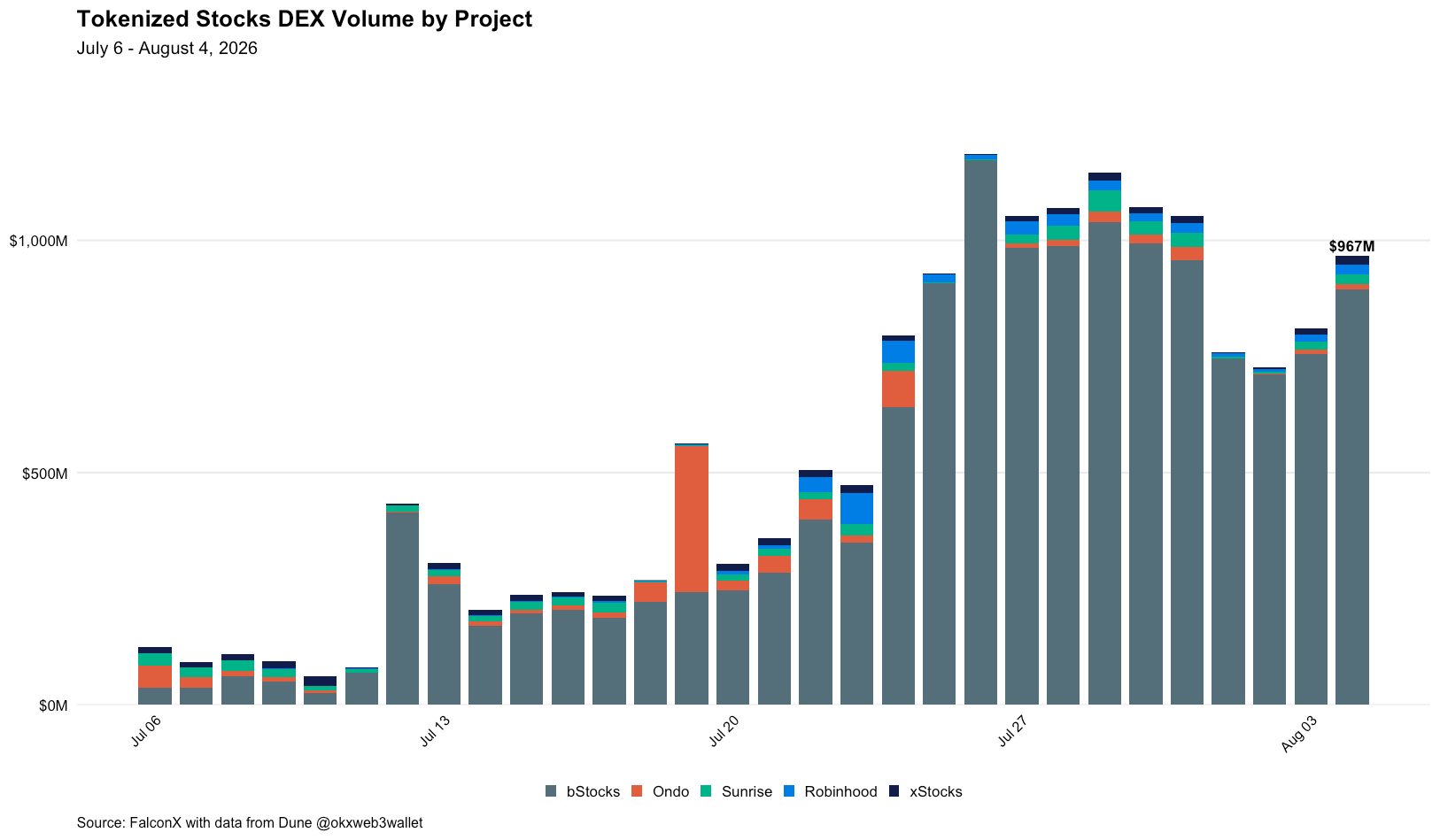
The convergence trend is occurring on-chain as well, with tokenized stock volumes rising into month end, with several days towards the end of July 2026 posting volumes of $1B+. This was nearly all driven by bStocks activity on BNB Chain, which largely runs through the Native liquidity infrastructure via Binance Wallet.
In just weeks, bStocks has emerged as a top tokenized stock platform by total value, ranking 3rd with $502M outstanding, per data from RWA.xyz as of Aug 3, 2026. This compares to xStocks and Ondo at $519M and $817M, respectively. It highlights the impact Binance’s distribution can have on a new product.
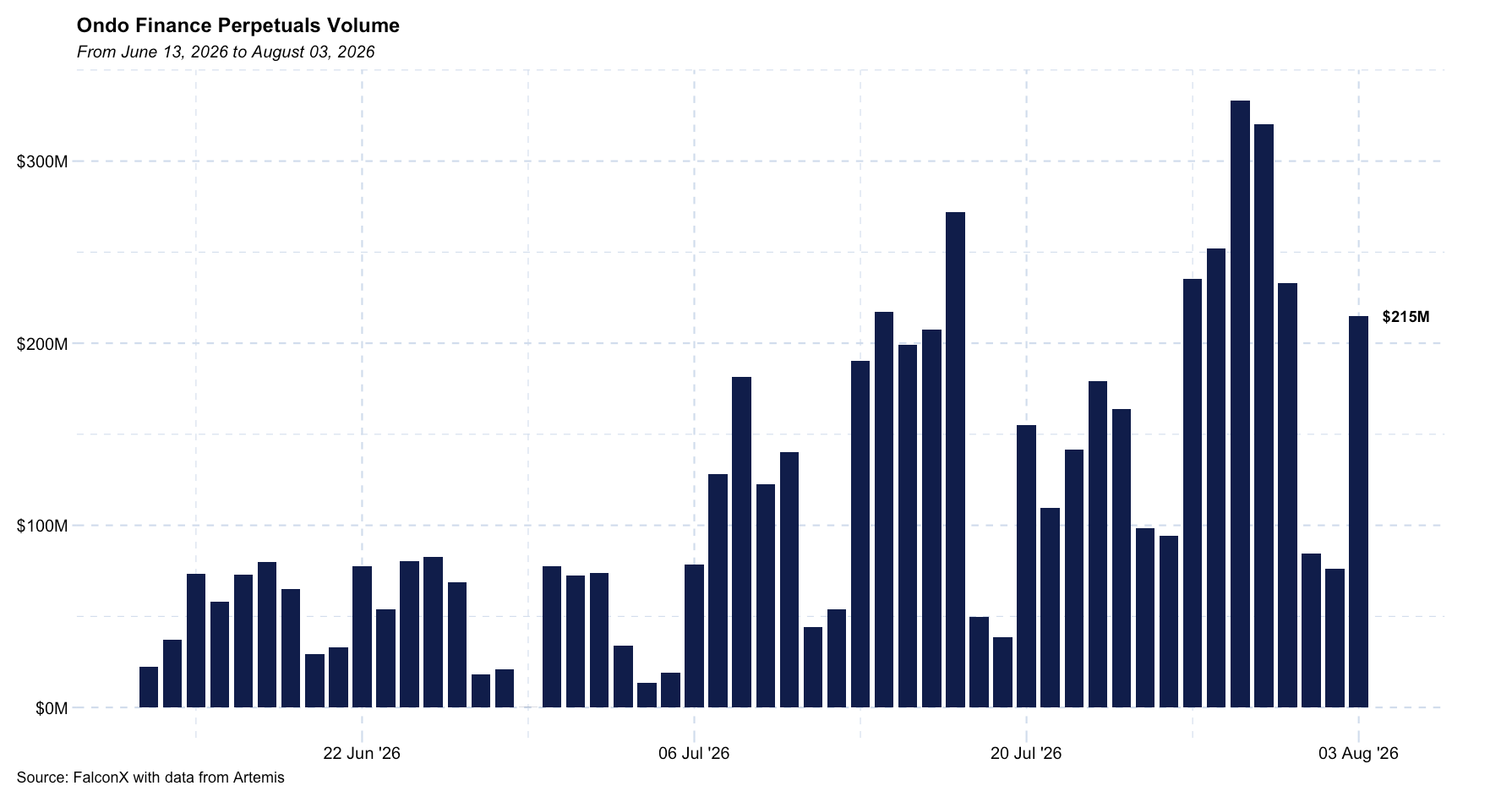
Ondo perps are also seeing growing activity after launching in June 2026, although may be partly explained by incentives around the launch.
Takeaways
Crypto exchange trading volume is increasingly shifting to traditional markets, with perps on single-name equities dominating the RWA category. RWA activity is also growing in spot markets, thanks to the recent roll outs of Binance and OKX tokenized stock offerings. Perp volumes in this category are tracking 5-25X higher vs spot volumes for major exchanges. Meanwhile, Binance is emerging as the leader in the ‘convergence’ narrative, with its RWA markets posting volumes nearly 4X that of Hyperliquid’s HIP-3 in recent months.
This material is for informational purposes only and is only intended for sophisticated or institutional investors. Neither FalconX Limited, FalconX Bravo, Inc., FalconX Delta, Inc., FalconX Golf Pte Ltd., Solios, Inc., Falcon Labs S. DE. R. L., KestrelX, Ltd., nor Banzai Pipeline Limited service retail counterparties, and the information in this material is NOT intended for retail investors. This material is not (i) an offer, or solicitation of an offer, to invest in, or to buy or sell, any interests or shares, or to participate in any investment or trading strategy, (ii) intended to provide accounting, legal, or tax advice, or investment recommendations, or (iii) an official statement of FalconX or any of its affiliates. Any information contained in this material is not and should not be regarded as investment advice, investment research, debt research, or derivatives research for the purposes of the rules of the CFTC or any other relevant regulatory body.
No discussion of a particular company or product shall be considered an endorsement of such company or product. Past performance is not indicative of future results. FalconX, and its affiliated parties, including 21shares, may hold positions in, act as a market maker for, or otherwise have a financial interest in, assets discussed herein, and may benefit from any price movements or transactions involving the subject company. This may change without notice.
Prior to entering into any proposed transaction, recipients should determine, in consultation with their own investment, legal, tax, regulatory and accounting advisors, the economic risks and merits, as well as the legal, tax, regulatory and accounting characteristics and consequences of the transaction. Pursuant to the Dodd-Frank Act, over the counter derivatives are only permitted to be traded by "eligible contract participants" (“ECP”s) as defined under Section 1a(18) of the CEA (7 U.S.C. § 1a(18)). Do not consider derivatives or structured products unless you are an ECP and fully understand and are willing to assume the risks.
Solios, Inc. and FalconX Delta, Inc. are registered as federal money services businesses with FinCEN. FalconX Bravo, Inc. is registered as a Swap Dealer with the U.S. Commodity Futures Trading Commission and is a member of the National Futures Association. FalconX Limited, FalconX Bravo, Inc., FalconX Delta, Inc., Falcon Labs S. DE. R. L., and Solios, Inc. are not registered with the Securities & Exchange Commission or the Financial Industry Regulatory Authority. FalconX Golf Pte. Ltd. is not registered or licensed by the Monetary Authority of Singapore (MAS). FalconX Limited is licensed by the MFSA as a Class 2 Crypto-Asset Service Provider (Regulation (EU) 2023/1114). It is also licensed as a Financial Institution (Cap. 376) exclusively for EMT payment services. FalconX is not a registered broker-dealer with the U.S. Securities and Exchange Commission (SEC) or a member of the Financial Industry Regulatory Authority (FINRA). FalconX’s ability to offer trading in tokenized stocks and other products mentioned herein may be restricted in certain jurisdictions.
"FalconX" is a marketing name for the FalconX Group and its affiliates. Availability of products and services is subject to jurisdictional limitations and capabilities of each FalconX entity. For information about which legal entities offer trading products and services, or if you are considering entering into a derivatives transaction, please reach out to your Sales or Trading representative.
.jpg)