How BTC Income Strategies are Shaping Options Dynamics
BTC Income ETFs now exceed $1.5B AUM and may be increasingly influencing the BTC options complex.

Investing in digital assets or tokenized equities involves a substantial degree of risk. Market prices can be highly volatile and unpredictable. Movements in the market can result in significant, rapid, and potentially total loss of your invested capital. Before allocating capital, you should carefully evaluate whether such investments align with your financial situation, experience, and risk tolerance. For further information regarding potential risks, please refer to the disclaimer below.
Bitcoin’s lack of native yield is driving increasing demand for yield-generating options strategies. This materializes in two key channels: 1) BTC income ETFs ($1.5B AUM) and 2) DATs and miners writing covered calls on their spot BTC ($3B+ in holdings across companies with disclosed programs).i Together, these forces may be increasingly impacting dynamics across the BTC options complex, namely Deribit and IBIT.
These vehicles differ in their approach. The income ETFs tend to hold shares of Bitcoin ETFs and trade options tied to those ETFs, rather than BTC directly. As IBIT is the largest and most liquid BTC ETF, the activity of these vehicles naturally shows up there. DATs and miners, on the other hand, hold spot BTC. The impact of their options activity can be partly reflected via Deribit as the crypto-native options venue.
BTC Income ETFs Grow to $1.5B AUM

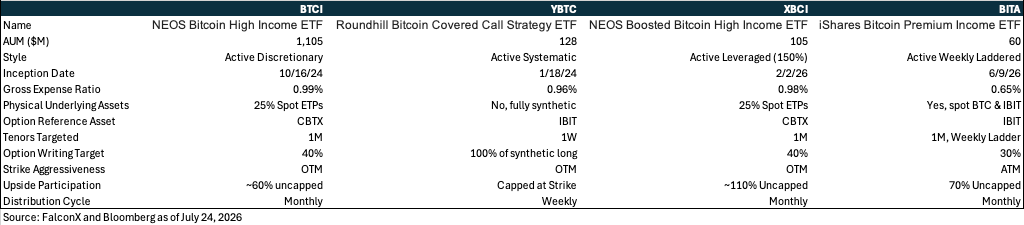
The BTC Income ETF segment has grown to over $1.5B AUM as of July 24, 2026. The NEOS Bitcoin High Income ETF (BTCI) leads the category with $1.1B AUM (73%), followed by the Roundhill Bitcoin Covered Call Strategy ETF (YBTC) at $128M and the NEOS Boosted Bitcoin High Income ETF (XBCI) at $105M. BlackRock also entered this space with its iShares Bitcoin Premium Income ETF (BITA) at $60M AUM, although its offering was launched recently (June 2026).
These vehicles differ in overwrite intensity, reference mechanics, and distribution cadence, which shapes the tenors they target. They are similar in providing structural call supply related to BTC ETF options, rather than Deribit BTC contracts.
These income ETFs have been brought to market under both Regulated Investment Company (RIC) and partnership fund structures. As a result, tax treatment of distributions can differ across funds in the category.
Understanding BTCI, the Largest BTC Income ETF Player
We can get an idea of how BTCI operates by looking at its holdings as of July 22, 2026. The fund kept 25% of its holdings in spot BTC ETFs (IBIT and HODL) and used an options structure to replicate the remaining exposure to spot BTC returns. It did this via a ~3-month tenor ATM matched strike call/put. The income generation used staggered call laddering, writing calls on two different strikes with ~1-month tenors.
BTCI wrote calls against roughly 40% of NAV, which equates to around $450M of notional exposure. The options it used were on CBTX, which is the Cboe Bitcoin U.S. ETF Index, a modified market cap basket of spot Bitcoin ETFs listed on U.S. exchanges.
YBTC, XBCI, and BITA
YBTC writes options on single-asset BTC ETPs, including IBIT, while BITA writes calls on IBIT options. XBCI is structured similarly to BTCI, using options on the Cboe Bitcoin U.S. ETF Index index options, but targets 1.5X leverage it creates via options exposure.ii
YBTC targets tenors of one week or less, although the more frequent rolls can lead to higher transaction costs. It aims to overwrite 100% of its synthetic BTC long exposure. This can drive more premium generation but caps upside on rallies past the strikes.
BITA is unique in that ~70% of its NAV is in spot BTC and ~30% in IBIT shares. It targets monthly expiries but uses weekly laddered overwrites to smooth premium collection and aims for notional exposure of around 25-35% of total assets.
The NEOS vehicles (BTCI and XBCI) maintain an active overlay. In periods of low volatility, discretionary options strategies could revolve around selling options closer to the money to maintain a level of premium. Conversely, when IV rises, selling OTM could be more attractive.
IBIT’s Role in Options Strategies
The presence of IBIT in these vehicles’ strategies may reflect IBIT’s position as the largest and most liquid spot BTC ETF, but its relatively outsized share in options activity is notable.

Examining options notional open interest for the 6 US spot ETFs above $1B AUM, IBIT holds a disproportionate share of options open interest relative to AUM – it holds 62% of the AUM across the peer set, yet 95% of notional options open interest, highlighting how options liquidity tends to follow a Pareto distribution.
How Structured Call Selling Can Weigh on Vols and Spot BTC
These income strategies revolve around repeated, calendar-driven selling of call vega, increasing the supply of out-of-the-money (OTM) calls relative to organic demand. Absent other factors, the supply/demand imbalance should compress call implied volatility versus puts and flatten or invert upside skew. This effect tends to be pronounced in expiries where the overwrites are concentrated, which is often the front-week and front-month IBIT/BTC strikes for weekly/monthly distribution funds instead of the far tenors/wings.
Scale is a practical limit of impact on the markets. According to data from Bloomberg and Coin Metrics, BTC Income ETF AUM of $1.5B compares to $23B of IBIT options open interest, while the DATs with publicly disclosed BTC options income programs have BTC holdings of around $3B vs Deribit’s BTC OI of $30B. Moreover, the actual impact on open interest tends to be lower than the vehicles’ holdings or AUM, as overwrites are typically done on only a portion of the book to maintain upside exposure in case of a rally. Overall, the potential size of these income programs suggests that they can impact the front end but likely do not alone explain broader BTC volatility regimes.
For spot BTC, dealer hedging can amplify any impact. Market makers that buy the calls become long call gamma, vega, and delta. They hedge by selling the underlying (IBIT or BTC) which can weigh on upside moves in the underlying. In a rally through the crowded short-call strikes, the delta of the dealer’s long calls rises, therefore they must sell more of the underlying to remain neutral, dampening the strength of the move up. Conversely, if the underlying price falls, dealers buy back the underlying to remain delta-neutral. This means dealers are selling into rallies and buying into dips when they are long the call.
Moreover, these strategies tend to perform the best when vols decline, implying they are structurally short vol increases. This means that this growing cohort of BTC yield seekers may be pushing the market towards a slower and gradual appreciation of BTC price than the short, explosive moves it has seen historically.
What the Data Shows
IBIT and Deribit BTC notional options open interest have been neck and neck for much of 2026. However, since June, Deribit BTC OI has ticked up considerably. IBIT’s share of IBIT-plus-Deribit notional reached about 50% at end-Q2 2026, then fell to about 43% by July 24 as Deribit rebounded to $29.8B while IBIT stabilized near $22.6B.
.png)
Put/call open interest diverged across these venues in 2026. IBIT P/C rose from about 0.32 at listing (November 22, 2024) to roughly 0.80 at 2Q26-end and 0.71 by mid-July 2026. Deribit BTC P/C (Laevitas notional) averaged 0.58 in 2025, then fell toward 0.44 by July 24 as Deribit call notional rebounded. The mean IBIT−Deribit P/C gap flipped from −0.07 in 2025 to +0.21 in July 2026: IBIT became relatively more put-heavy than Deribit, even though calls still dominate both books. This suggests investors may increasingly prefer IBIT as the vehicle for expressing downside views, while crypto-native investors may prefer Deribit for calls.
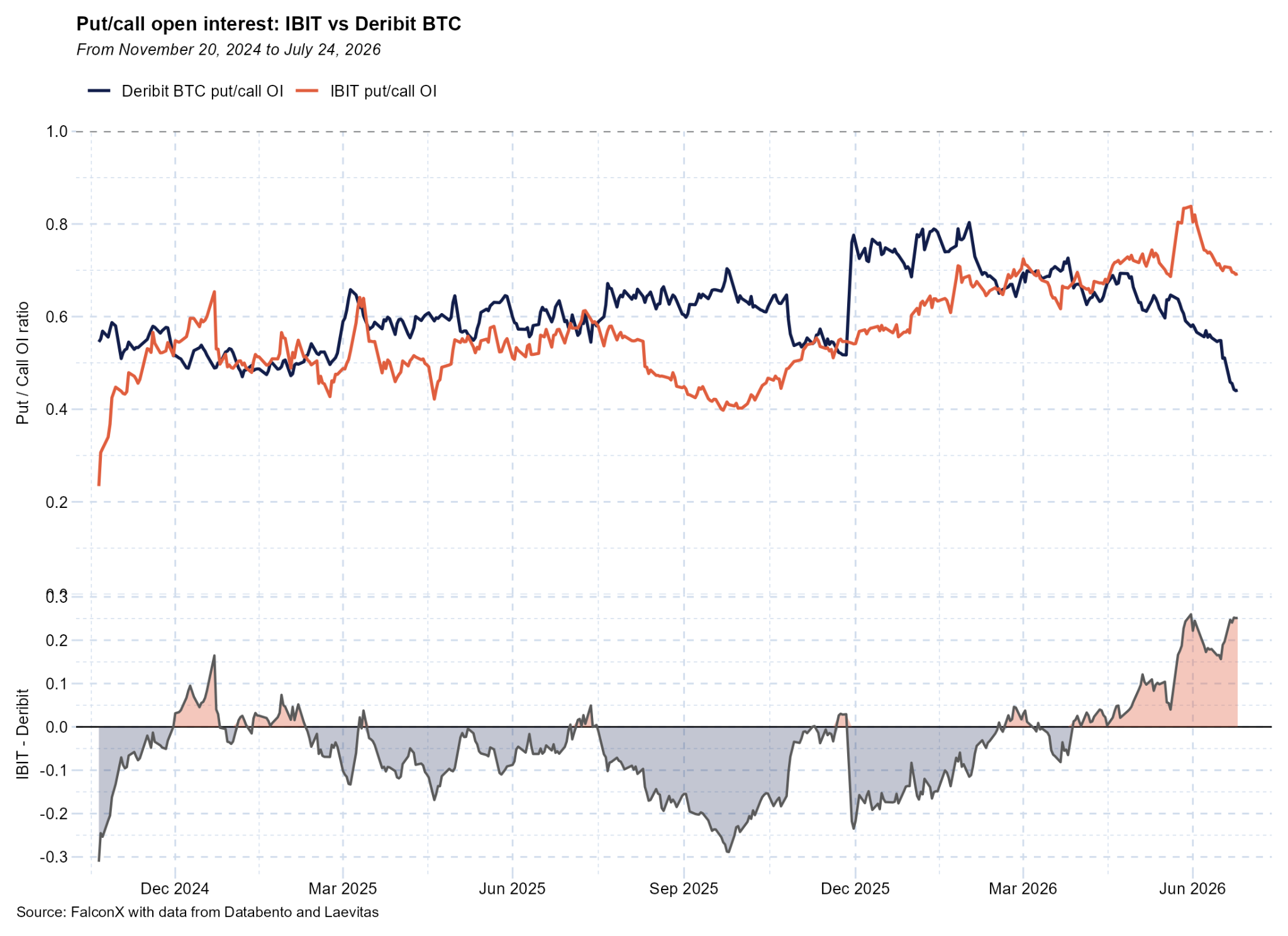
Deribit’s P/C ratio has declined significantly since hitting a high in March 2026. The decline March-June was driven by puts rolling off, while July’s decline saw call OI jump sharply. Deribit’s latest P/C of 0.44 is the lowest since at least 2024 and compares to the prior low of around 0.47 in February 2025. Since then, Deribit’s BTC call open interest has increased $3.5B vs $1.1B for puts, suggesting there may be some credence to the overwriting story.
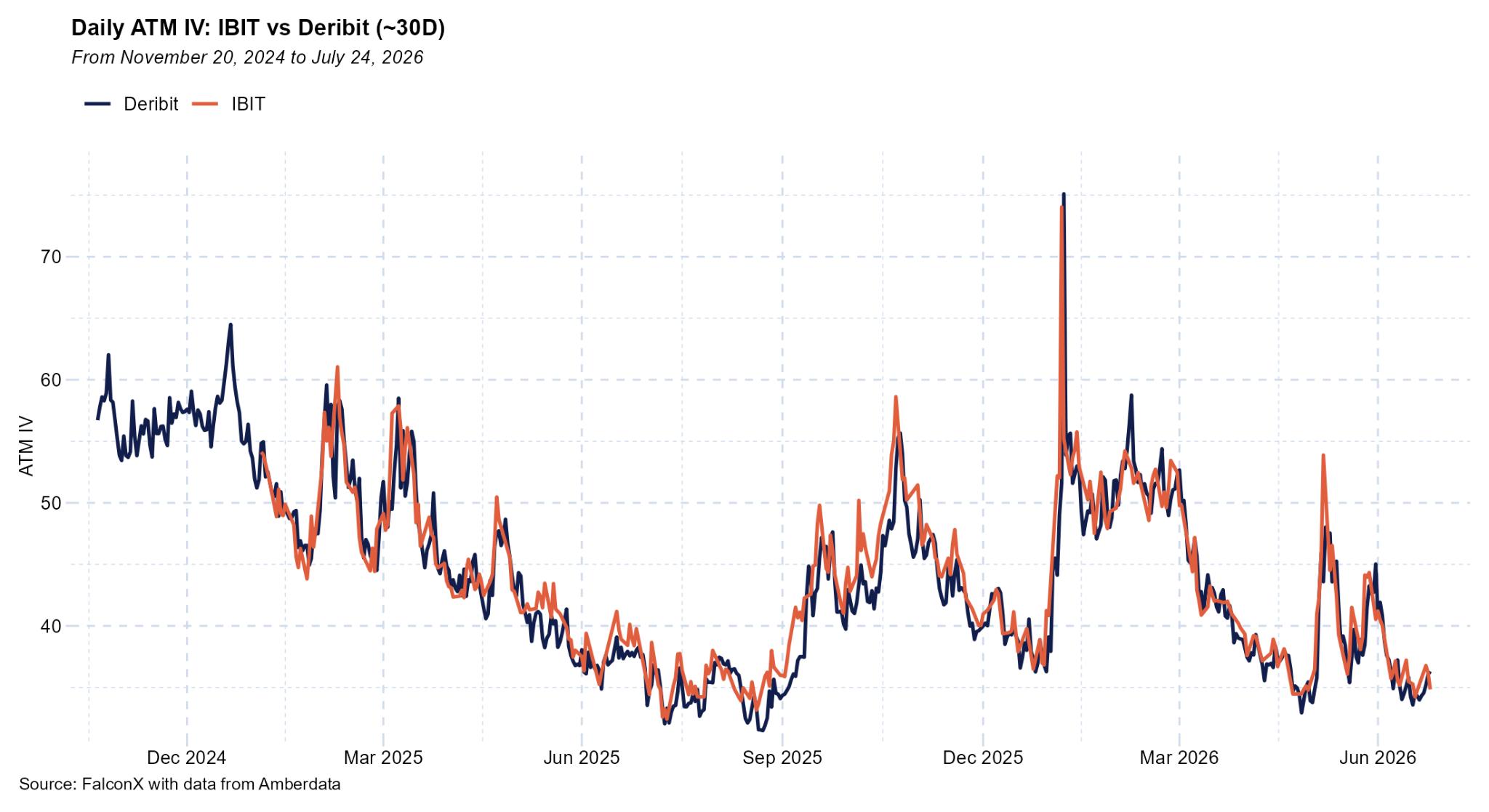
Volatility surfaces point to call-supply pressure rather than a blanket “vols are down” narrative. IBIT ~30D ATM was rich to Deribit at listing (+4.7 vol points on November 22, 2024; +6.2 a month later), then convergent through 2026. Continuous Amberdata series put the mean IBIT-Deribit ATM spread at about +0.6 in 2025, +0.4 in Q2 2026, and roughly flat in July. This could support early listing scarcity giving way to persistent overwriting. The decline in IBIT’s ATM premium could be consistent with more IBIT call supply and/or arbitrage bringing the two books together.
IBIT 20-delta call wings turned systematically cheap vs ATM (negative on 96% of Q2 sessions) while put wings stayed rich, a possible imprint of structured call selling on IV. This means the market is not paying up for extreme tail moves, despite BTC’s history of explosive price action. Deribit showed similar results with its 20-delta call wings cheap in 100% of Q2 sessions and was cheaper than IBIT ~65% of Q2 days.

Deribit risk reversals co-moved but were not identical day-to-day. IV-RV remains the main confounder for any Deribit ATM story, and early July 2026 saw RV outrun IV.
.png)
Assessing The Impacts of Instruments Involved
The largest Bitcoin income ETFs primarily use index options and IBIT options, which can affect broader BTC complex vols indirectly. There are three avenues where the dynamics could shape up.
Dealer delta and gamma hedging is one route where market makers hedge long IBIT calls by selling IBIT, which can spill over into spot BTC or BTC futures markets. This hedging can alter US-session realized vol and the path of spot that Deribit options settle against. Separately, desks that warehouse both IBIT and Deribit books may reduce Deribit call inventory when IBIT call wings cheapen, selling crypto-native upside vol to keep a cross-venue vega book closer to flat. The result is not identical smiles, but correlated softening of call IV during overlapping US hours.
There is the potential for arbitrage around the difference in IBIT and Deribit structures, where vol desks buy IBIT vol and sell Deribit (or vice versa), bridging IBIT overwrite pressure into crypto-native IV. The compression of the IBIT–Deribit ATM spread from multi-vol-point richness at listing toward flat by mid-2026, per data from Amberdata, is consistent with that channel operating over time, even if day-to-day residuals remain. BTC CME options sit between the two venues as another hedge and arb leg, though remain relatively small at roughly $600M open interest as of July 24, according to data from Velo.
Advisor and retail “yield on bitcoin” demand that might once have been expressed as covered calls or short vol on Deribit increasingly sits inside ETF wrappers. Deribit can lose that particular call-selling supply, even while absolute Deribit OI rises for other reasons (basis hedges, miners, funds, longer-dated BTC-denominated risk). Because IBIT options trade regular market hours, more of the overwrite imprint could show up in US-equity-hours Deribit volume and gamma, rather than uniformly across the Asian overnight.
Takeaways
The data indicates signs of overwriting across IBIT and Deribit, with cheap call wings across both, while put wings have remained rich. The IBIT-Deribit ATM spread compressed to near parity while BTC income ETF AUM grew from $0.3B in early 2025 to $1.5B today, per data from Bloomberg, potentially reflecting the growing overwriting supply. Across both venues, we observe the put/call ratio below 1, with OI leaning towards calls, which may also indicate the growing presence of overwriting open interest.
Over time, growing demand for income generation could translate to an increase of call OI share in the front week or month tenors. IBIT front month call OI share is still below Deribit’s; if these income ETFs continue to grow, we could eventually see this flip.
i BTC DATs and miners with publicly announced options income strategies include Metaplanet, Nakamoto, and CleanSpark.
ii Data from the fact sheets and prospectuses of these ETFs.
This material is for informational purposes only and is only intended for sophisticated or institutional investors. Neither FalconX Limited, FalconX Bravo, Inc., FalconX Delta, Inc., FalconX Golf Pte Ltd., Solios, Inc., Falcon Labs, S. de R. L., KestrelX, Ltd., nor Banzai Pipeline Limited service retail counterparties, and the information in this material is NOT intended for retail investors. This material is not (i) an offer, or solicitation of an offer, to invest in, or to buy or sell, any interests or shares, or to participate in any investment or trading strategy, (ii) intended to provide accounting, legal, or tax advice, or investment recommendations, or (iii) an official statement of FalconX or any of its affiliates. Any information contained in this material is not and should not be regarded as investment advice, investment research, debt research, or derivatives research for the purposes of the rules of the CFTC or any other relevant regulatory body.
No discussion of a particular company or product shall be considered an endorsement of such company or product. Past performance is not indicative of future results. FalconX, and its affiliated parties, including 21shares, may hold positions in, act as a market maker for, or otherwise have a financial interest in, assets discussed herein, and may benefit from any price movements or transactions involving the subject company. This may change without notice.
Prior to entering into any proposed transaction, recipients should determine, in consultation with their own investment, legal, tax, regulatory and accounting advisors, the economic risks and merits, as well as the legal, tax, regulatory and accounting characteristics and consequences of the transaction. Pursuant to the Dodd-Frank Act, over the counter derivatives are only permitted to be traded by "eligible contract participants" (“ECP”s) as defined under Section 1a(18) of the CEA (7 U.S.C. § 1a(18)). Do not consider derivatives or structured products unless you are an ECP and fully understand and are willing to assume the risks.
Solios, Inc. and FalconX Delta, Inc. are registered as federal money services businesses with FinCEN. FalconX Bravo, Inc. is registered as a Swap Dealer with the U.S. Commodity Futures Trading Commission and is a member of the National Futures Association. FalconX Limited, FalconX Bravo, Inc., FalconX Delta, Inc., Falcon Labs S. DE. R. L., and Solios, Inc. are not registered with the Securities & Exchange Commission or the Financial Industry Regulatory Authority. FalconX Golf Pte. Ltd. is not registered or licensed by the Monetary Authority of Singapore (MAS). FalconX Limited is licensed by the MFSA as a Class 2 Crypto-Asset Service Provider (Regulation (EU) 2023/1114). It is also licensed as a Financial Institution (Cap. 376) exclusively for EMT payment services.
"FalconX" is a marketing name for the FalconX Group and its affiliates. Availability of products and services is subject to jurisdictional limitations and capabilities of each FalconX entity. For information about which legal entities offer trading products and services, or if you are considering entering into a derivatives transaction, please reach out to your Sales or Trading representative.
.jpg)